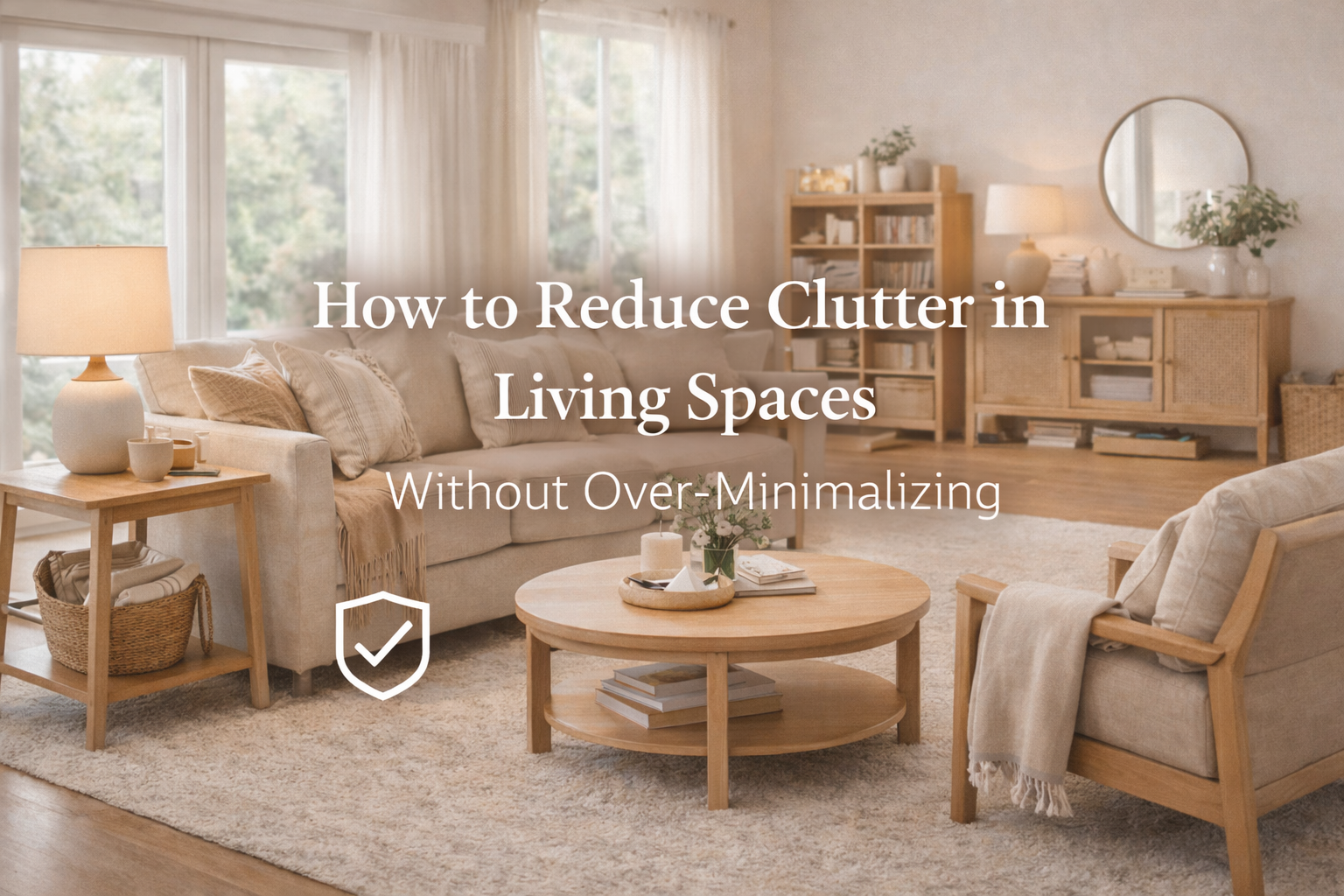
How to Reduce Clutter in Living Spaces Without Over-Minimalizing
How to reduce clutter in living spaces is one of the most common goals homeowners have, but it is often approached in the wrong way. Many people assume clutter is a discipline problem. They think the solution is to become more organized, buy better storage boxes, or simply “keep things tidy.”
In reality, clutter is usually a design problem. It forms where storage is inconvenient, where routines are not supported, and where furniture does not match daily behavior. Clutter is rarely random. It follows predictable patterns.
A home that feels calm is not necessarily minimalist. It is simply a home where objects have logical places, surfaces are not forced to carry too many functions, and daily habits are supported rather than resisted.
This guide explains how to reduce clutter in living spaces in a realistic, practical way without turning your home into an empty showroom.
Why Clutter Forms Even in Well-Designed Homes
Clutter often forms in homes that are genuinely beautiful. That’s because aesthetics don’t automatically create usability. A space can look styled and intentional, yet still feel messy in daily life if the layout and storage don’t support real routines.
In most cases, clutter forms in three predictable ways:
- Objects don’t have an obvious “home”
- Storage is too far from where items are actually used
- Furniture doesn’t support routine behavior
The most common example is the “drop zone.” People come home and naturally place keys, bags, jackets, and small items on the nearest available surface. If the home doesn’t include a designed drop zone, clutter will create one on its own usually on a dining table, a kitchen counter, or a hallway chair.
This is why learning how to reduce clutter in living spaces starts with observation rather than resistance. The goal isn’t to fight everyday habits. The goal is to design around them. When a home supports behavior, order becomes easier to maintain without constant effort.
This idea is closely tied to routine-based design, which we explore further in our guide to interior design and daily behavior.
Reduce Clutter by Designing Better “Landing Areas”
Landing areas are where objects naturally accumulate.
These include:
- entryway tables
- kitchen counters
- dining tables
- coffee tables
- bedside tables
The goal is not to eliminate landing areas. The goal is to control them.
A controlled landing area has:
- a defined surface size
- a tray or container system
- nearby storage for overflow
When landing areas are controlled, clutter stays contained.
This is one of the most effective strategies in how to reduce clutter in living spaces, because it works with behavior instead of against it.
Storage Must Be Located Where the Behavior Happens
Storage is often placed where it looks good rather than where it is needed.
For example, shoes are stored in a distant closet instead of near the door. Chargers are stored in drawers instead of near seating. Cleaning supplies are stored far from the areas where they are used.
This mismatch creates clutter because objects will always remain near where they are used most.
The simplest rule is:
If an object is used daily, its storage must be accessible daily.
This is not a minimalism principle. It is a usability principle.
How Furniture Choices Influence Clutter
Furniture can either quietly reduce clutter or unintentionally create it. This is one of the reasons some homes feel naturally organized while others constantly struggle, even when the owners are equally tidy.
Furniture that reduces clutter usually has one thing in common: it supports everyday storage without looking like “storage furniture.” Pieces like storage benches, coffee tables with drawers, sideboards placed near dining zones, and media units with closed compartments all help contain the small objects that tend to accumulate in daily life. Even shelving systems can be effective when they balance open display space with closed sections that hide practical items.
On the other hand, furniture that creates clutter often fails because it looks good in theory but doesn’t support routine. A living room with no side tables forces people to leave objects on the sofa or the floor. Fragile decorative tables become useless for daily life, so items end up scattered across any available surface. Open shelving without a clear organization strategy can quickly turn into visual noise, even if the room is technically “clean.”
This is why furniture planning is an essential part of reducing clutter. Storage isn’t an accessory or an afterthought it’s functional architecture. When furniture supports daily behavior, the home stays calmer with far less effort.
For a deeper room-by-room approach, our home furniture planning guide explains how to build a space that stays functional long term, even as routines change.
Reduce Visual Clutter by Limiting Open Storage
Open shelves look stylish in photos, but they require constant maintenance.
Open storage is not inherently bad, but it must be used intentionally. If every shelf becomes a mix of random objects, the room feels visually busy.
A practical strategy is to balance:
- closed storage for everyday clutter
- open storage for curated display
This prevents the home from feeling messy while still allowing personality.
Why Surfaces Become Clutter Magnets
Surfaces collect clutter because they are convenient. The problem is not that surfaces exist. The problem is that too many surfaces become “temporary storage” forever.
Dining tables are the most common clutter magnet because they are large, central, and easy to access.
To reduce this problem:
- define the dining table as a “clean surface”
- add storage nearby for paperwork and daily objects
- use trays for controlled accumulation
This approach supports routines without forcing constant discipline.
Habit Systems That Actually Work
Most clutter solutions fail because they require unrealistic habits.
Instead of trying to change your personality, build systems that support your existing behavior.
Effective systems include:
- one dedicated basket for incoming items
- one weekly reset day
- designated zones for common clutter categories
- furniture placement that supports natural flow
The goal is to reduce decision-making.
If you have to think about where to put something, clutter will win. If storage is obvious, order becomes natural.
FAQ
What is the fastest way to reduce clutter in living spaces?
Create a controlled entryway drop zone and add closed storage near high-use areas.
Why does clutter always return?
Because storage systems don’t match daily behavior, so objects end up on surfaces again.
Does reducing clutter require minimalism?
No. It requires practical storage placement and habit-supporting furniture.
Are open shelves bad for clutter?
Not always, but they require curation. Too much open storage increases visual noise.
How do I reduce clutter without buying new furniture?
Reorganize storage to match where items are used and create dedicated zones for common clutter categories.
Conclusion
Learning how to reduce clutter in living spaces is not about becoming more disciplined or living with fewer possessions. It is about designing a home that supports behavior. When storage is accessible, landing areas are controlled, and furniture supports daily routines, clutter naturally decreases.
A calm home is not an empty home. It is a home where objects belong somewhere, and daily life doesn’t fight the design.