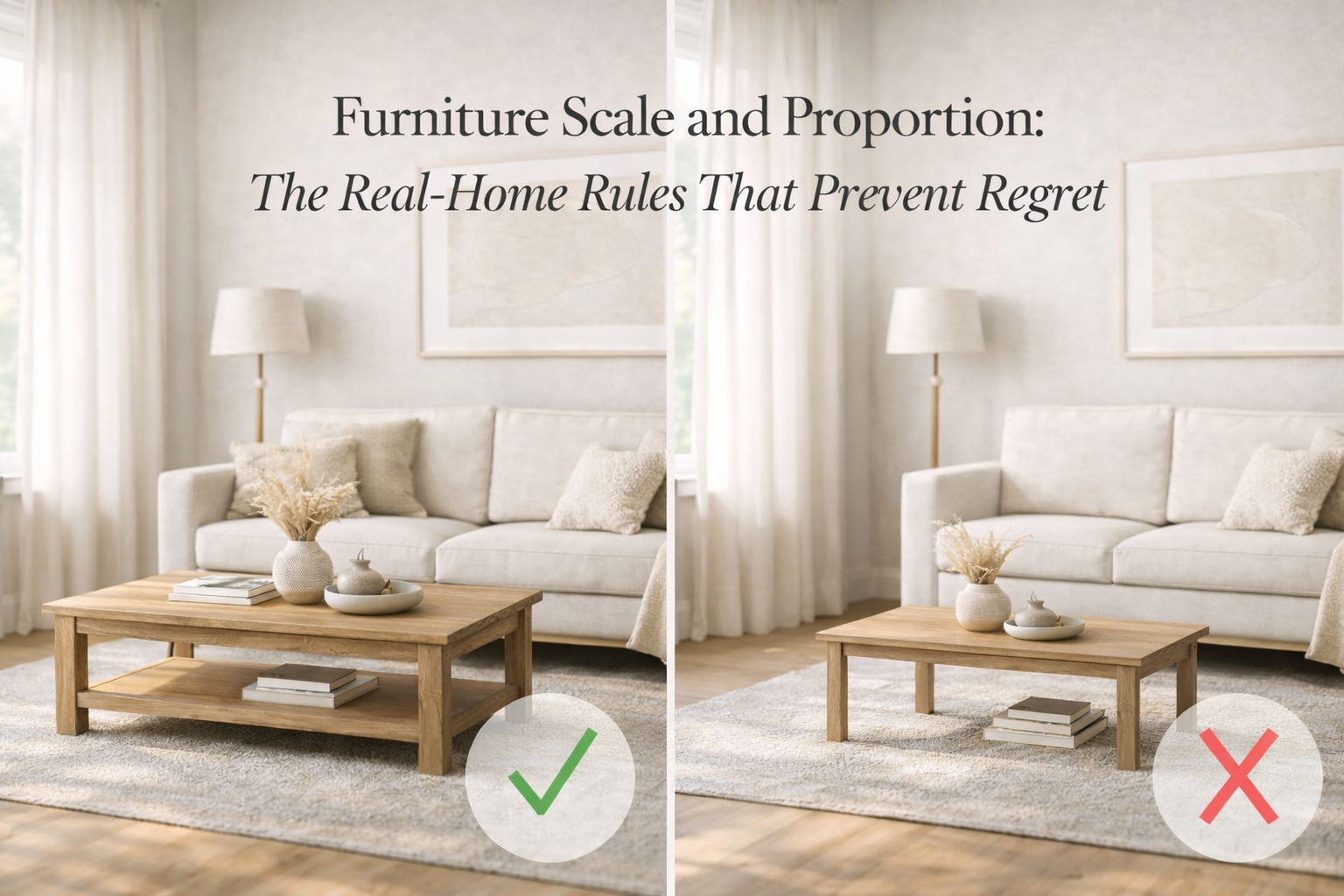
Furniture Scale and Proportion: The Real-Home Rules That Prevent Regret
Furniture scale and proportion is one of those topics people rarely think about until something feels wrong. A sofa arrives and suddenly the room feels smaller. A dining table fits on paper but makes movement awkward. A cabinet looks perfect online but feels visually heavy under a lower ceiling. These regrets are common and they rarely come from bad taste or low-quality furniture. They come from scale.
In real homes, furniture is not experienced as an individual object. It is experienced as part of a system. Every piece interacts with walls, ceilings, walkways, windows, light, and the other items in the room. That means proportion can’t be solved by measurements alone. It has to be solved by relationship how furniture sits in a space, how it affects flow, and how it feels after routine begins.
This guide explains furniture scale and proportion in a practical way: how to recognize the most common mistakes before you buy, how to evaluate furniture once it’s in the room, and how to create balance without overthinking design.
If you’re building a room-by-room approach, this article pairs well with our furniture guide for every room, which brings these concepts into a full planning framework.
Why Furniture Scale and Proportion Matter More Than Style
Style is obvious. Scale is subtle.
A room can be beautifully styled and still feel uncomfortable if scale is wrong. People often describe the feeling as:
- “It looks nice, but something feels off.”
- “The room feels cramped.”
- “It’s hard to move around.”
- “The furniture feels too heavy.”
These reactions are almost always scale-based.
Scale affects both:
- physical comfort (how easy it is to move)
- visual comfort (how calm the room feels)
When scale is right, rooms feel effortless. When scale is wrong, rooms feel like they require constant adjustment.
This is why scale is often what separates a home that looks good from a home that feels good.
Furniture Scale and Proportion Start With Circulation
The simplest scale test is circulation. If the room’s movement paths are compromised, scale is off—even if the furniture technically “fits.”
A practical mindset is: furniture should support walking, not just sitting.
Common circulation issues include:
- tight pathways that force sideways movement
- chair clearance that requires constant repositioning
- furniture corners that interrupt natural flow
- door swings blocked by cabinets or benches
A room can handle large furniture if the circulation remains clean. A room can feel cramped with smaller furniture if circulation is blocked in the wrong places.
If you want a deeper breakdown of how movement reveals fit in everyday life, our guide on how furniture fits real homes explains why layout assumptions often fail after routine begins.
The “Breathing Room” Rule
Breathing room is what makes a space feel calm.
It’s not only about empty space it’s about usable space that makes movement and daily life easier.
Breathing room appears in three places:
- Around furniture edges
- Between seating and tables
- In visual negative space
This is why slightly smaller furniture often feels more luxurious in real life. It allows the room to function naturally. It reduces friction. It makes the space feel stable.
Breathing room is also one of the most underrated tools for cohesion. Rooms feel cohesive when furniture weights feel balanced, not crowded.
How to Evaluate Visual Weight (Not Just Size)
Two pieces can be the same size but feel completely different in a room.
That’s because visual weight is influenced by:
- color (dark pieces feel heavier)
- base design (raised legs feel lighter)
- material (solid wood feels heavier than glass)
- silhouette (bulky arms vs slim arms)
- height (tall pieces dominate faster)
A deep sofa in a narrow room isn’t only physically dominant it’s visually dominant. A tall cabinet under a low ceiling doesn’t only take space it pulls attention upward, making the room feel shorter.
Visual weight is why scale mistakes feel emotional. The room feels “heavier,” even if you can’t explain why.
Furniture Scale and Proportion in Living Rooms
Living rooms are where scale mistakes are most common because people prioritize comfort and “big cozy seating.”
The most common problems include:
- sofas too deep for the room’s width
- sectionals that dominate circulation
- coffee tables that are too large or too small
- rugs that are undersized, making seating feel scattered
The easiest way to stabilize a living room is to treat it as a defined zone. If the living room seating doesn’t feel connected, scale will always feel off.
If you need a full layout framework, our guide on how to arrange furniture in a living room breaks down flow and seating balance in a practical way.
Dining Rooms: The Chair Clearance Test
Dining rooms are often where “it fits” becomes “it doesn’t work.”
A dining table can fit the room dimensions and still fail in daily use because chairs need clearance.
The chair clearance test is simple:
- can chairs slide back without hitting a wall?
- can someone walk behind a seated person comfortably?
- does the table dominate the walkway?
Oversized dining tables create constant friction. People bump into corners. Chairs feel cramped. Movement becomes awkward.
If you want a broader planning approach, our furniture guide for every room explains how to make dining furniture decisions based on routines, not aesthetics.
Bedrooms: Scale Is About Calm, Not Filling Space
Bedroom scale mistakes often come from trying to “fill” the room.
A bedroom doesn’t need lots of furniture. It needs the right proportions.
Common mistakes:
- bed frame too large for circulation
- nightstands too small relative to bed
- wardrobe too bulky for the room’s visual balance
Bedrooms benefit from fewer, more stable pieces. A calm room feels more spacious, even if it contains less.
Scale also affects mood. A room with oversized furniture can feel visually loud, even if the colors are soft.
How Proportion Creates Cohesion Automatically
Cohesion often comes down to proportion.
When furniture feels consistent in scale and visual weight, rooms feel unified even if styles vary.
When one room has oversized heavy furniture and another has light minimal furniture, the home feels disjointed. Not because styles clash, but because scale logic changes.
This is why learning furniture scale and proportion often becomes the fastest route to a cohesive home.
If you want a full cohesion framework, our guide on how to make a home feel cohesive explains how repetition and balance create harmony without matching everything.
Practical “Before You Buy” Checklist
Here’s a quick scale checklist you can use before purchasing any major piece:
- Does the piece support circulation, not block it?
- Does the piece have breathing room on at least two sides?
- Does its visual weight match the room (color, legs, bulk)?
- Will it still feel comfortable once daily items exist in the space?
- Does it work with the room’s anchor points (windows, doors, focal walls)?
This checklist prevents most regrets.
FAQ
What is the difference between furniture scale and proportion?
Scale is how large a piece feels in a room. Proportion is how its parts relate to each other and to surrounding furniture, affecting balance.
Why does furniture that fits on paper feel wrong at home?
Because light, circulation, and visual weight change how furniture is perceived once it’s placed in a real environment.
How do I make a room feel bigger without removing furniture?
Improve circulation, add breathing room by shifting placement, and reduce visual weight by choosing pieces with legs or lighter silhouettes.
What is the most common scale mistake in living rooms?
Sofas that are too deep or sectionals that dominate the room and interrupt natural movement paths.
How can I prevent furniture regrets?
Use circulation tests, evaluate visual weight, and plan furniture as a system. Our furniture guide for every room is a strong starting point.
Conclusion
Understanding furniture scale and proportion is not about becoming a designer. It’s about learning the real-home rules that prevent regret. When furniture supports circulation, leaves breathing room, and maintains balanced visual weight, rooms feel calmer, more functional, and more cohesive without needing constant adjustment.
The best furniture choices don’t just fit a space. They make the space easier to live in.
For a full room-by-room planning framework, refer back to our furniture guide for every room, and use these scale principles as your filter before every major purchase.