Home & Living: Practical Ideas To Create A Comfortable, Functional Space
There’s a version of “home & living” advice that sounds dreamy, big renovations, perfectly styled shelves, and endless shopping lists. But most of us don’t live there. We live in real homes with real schedules, limited space, and budgets that need to stretch.
The good news: a comfortable, functional home usually comes from a handful of smart decisions repeated consistently, how we store things, how we move through rooms, where light lands, and what we choose to keep (or not). Below, we’re walking through practical, high-impact ways to make your space work better without turning your life into a never-ending project.
Define Your Lifestyle, Needs, And Priorities
Before we buy bins, shuffle furniture, or repaint a wall, we need clarity. A home that feels “right” is usually just a home aligned with how we actually live.
How You Use Each Room Day To Day
A functional home starts with an honest inventory. Not the Pinterest version, your version.
Try this quick exercise: for one week, we jot down how each room gets used.
- Kitchen: Are we cooking most nights, or assembling quick meals? Do we need counter space for prep, or a landing zone for delivery bags and lunchboxes?
- Living room: Is it mainly for relaxing, or is it also our work-from-home overflow, kids’ play area, or workout space?
- Bedroom: Is it truly a sleep-first zone, or are we folding laundry there, watching TV, and storing half our life?
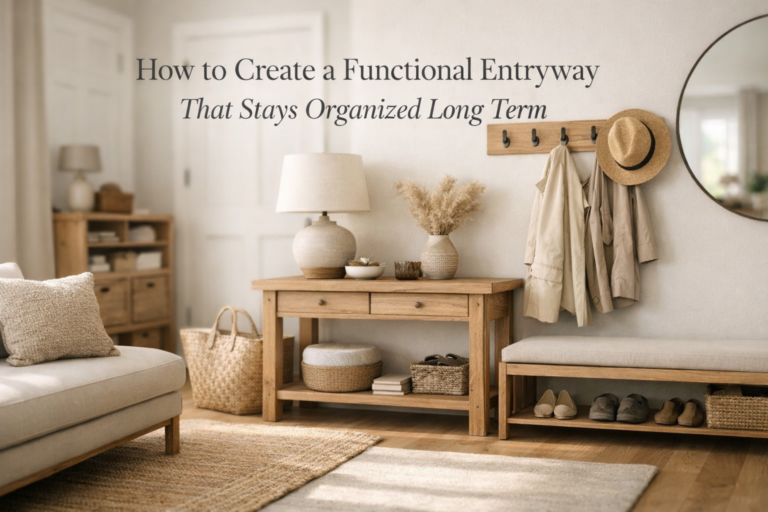
- Entryway: Do we actually have one? Or is the “entry” a corner where shoes, bags, and packages pile up?
When we see the patterns, we can give each room a clear job. That single change prevents the slow creep of random stuff that makes a home feel chaotic.
A helpful question: What’s the #1 frustration in this room?
- “We can’t find chargers.”
- “There’s nowhere to drop keys.”
- “The dining table is always covered in mail.”
Those frustrations are design clues.
Setting A Realistic Budget And Timeline
In home & living projects, momentum matters. If we set a huge plan with a vague timeline, it becomes a background stressor. Instead, we aim for “small wins” with defined constraints.
We like to set budgets in three layers:
- Free (0–$50): Declutter, rearrange furniture, use what we already own, add a hook rack, replace bulbs.
- Small upgrades ($50–$300): Drawer inserts, storage ottoman, area rug, better laundry hamper system, a real bedside lamp.
- Targeted investments ($300+): A sofa that fits the room, a high-quality mattress, built-in-looking storage, a durable dining table.
Then we choose a timeline that matches our bandwidth:
- One weekend: One room “reset” (declutter + layout + a few essentials).
- One month: Two to three focused upgrades without burnout.
- One season: Bigger improvements like paint, lighting changes, and replacing key furniture pieces.
The goal isn’t speed. It’s follow-through. A finished 80% plan beats a perfect plan that lives in notes forever.
Make Your Home More Functional Without Renovating
We don’t need to knock down walls to make daily life easier. A lot of functionality comes from systems, where things live, how quickly we can put them away, and whether storage matches reality.
Declutter With Simple Systems That Stick
Decluttering works best when it’s less emotional and more operational. Instead of asking, “Do we love this?” we ask:
- Do we use this weekly, monthly, or rarely?
- Would we buy it again today?
- Does it earn its space? (Especially in small homes.)
A simple system that tends to stick:
- One bag, one category, 15 minutes. We choose a single category, expired pantry items, old cables, socks, mugs, and fill one donation bag or trash bag. Stop there.
- Create a ‘maybe box.’ If we hesitate, it goes in a box with a date on it. If we don’t open it in 30–60 days, we donate it.
- Give everything a “parking spot.” If an item doesn’t have a home, it becomes clutter by default.
If we want to make this truly sustainable, we also reduce “incoming.” For example: we keep a one-in, one-out rule for decorative items, kitchen gadgets, and throw pillows (yes, the pillow population grows fast).
Optimize Storage For Small And Awkward Spaces
Most homes have weird gaps: that narrow cabinet, the corner behind a door, the space above the fridge, the shallow bathroom drawer. We can make those areas work with the right approach.
High-impact storage moves:
Go vertical: Wall hooks, peg rails, tall shelving, and over-the-door organizers. Vertical storage keeps floors clear, which instantly makes a space feel calmer—and it’s one of the simplest strategies we highlight in our guide on how to reduce clutter in living spaces.
Use contained categories: Bins and baskets work best when each one holds a single category (batteries, baking, dog gear). Mixed bins almost always turn into junk bins.
Choose clear or labeled containers: If we can’t see it or identify it quickly, we won’t use it.
Measure first: Especially in awkward spaces. A tape measure prevents the classic “it almost fits” problem.
Small-space tip we swear by: store by where we use things, not by where there’s room. Cleaning supplies near the bathroom, not buried under the kitchen sink. Work supplies near the desk, not scattered across closets. This is the difference between a home that looks organized and one that feels organized—and it ties directly into building a space around routine, as explained in our home furniture planning guide.
Improve Layout, Flow, And Everyday Convenience
A room can be beautifully decorated and still feel off if the layout fights us. Flow is about how we move, carrying laundry, setting down groceries, getting kids out the door, hosting friends.
Furniture Placement For Better Movement And Use
We don’t need a bigger room: we need fewer obstacles.
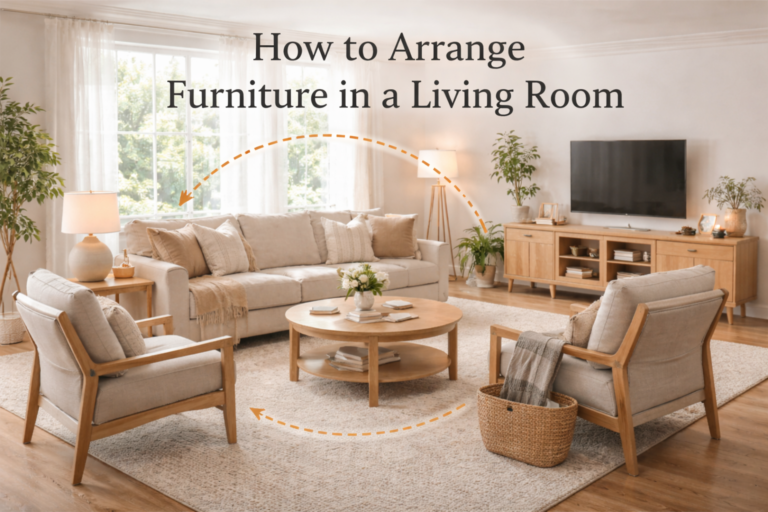
A few layout rules that usually improve flow immediately:
- Keep clear pathways: Ideally 30–36 inches for main walkways (less in tight apartments, but aim for “no side-shuffling”).
- Float furniture when it helps: Pushing everything against walls can create dead space in the middle and awkward edges. Sometimes pulling the sofa forward and adding a slim console behind it makes the room feel intentional.
- Right-size the rug: A too-small rug makes a room feel fragmented. In living rooms, we try to fit at least the front legs of main seating on the rug.
- Anchor with function: Coffee tables should be reachable, side tables should actually hold a lamp and a drink, and seating should face each other enough to talk without yelling.
If a room feels cramped, we ask: Which one piece is doing the most damage? Often it’s an oversized chair, a bulky coffee table, or a storage piece that belongs somewhere else.
Zones For Work, Relaxation, And Shared Areas
Many of us need rooms to do double (or triple) duty. Zoning is how we prevent those duties from blending into one stressful mess.
Ways to create zones without building walls:
- Use lighting as a boundary: A floor lamp defines a reading corner. A desk lamp signals “work mode.”
- Use rugs to “frame” a space: One rug for living, a smaller one for a desk nook.
- Face furniture toward the purpose: If the chair faces the TV, it becomes TV seating. If it faces a shelf and lamp, it becomes reading seating.
- Use open shelving or curtains: A bookshelf can separate a desk from the living area: a ceiling-mounted curtain track can hide a messy work zone fast.
The win here is psychological. When we can visually “clock out,” home feels restful again, even in small spaces.
Create Comfort Through Light, Color, And Texture
If we want a home to feel good, we can’t ignore the sensory stuff. Light affects mood and energy. Color affects how spacious or cozy a room feels. Texture is what makes a space feel lived-in rather than flat.
Layered Lighting For Mood And Task Needs
Most homes rely too heavily on one overhead light. It’s efficient, sure, but not exactly comforting.
We aim for three layers:
- Ambient: General light (ceiling fixture, recessed lights).
- Task: Focused light where we do things (desk lamp, under-cabinet lighting, bedside reading lamp).
- Accent: Light that adds warmth and depth (wall sconces, picture lights, small table lamps).
A quick upgrade that changes everything: swap bulbs thoughtfully.
- Warm white bulbs (around 2700K–3000K) make living rooms and bedrooms feel calmer.
- Neutral white (around 3500K) works well in kitchens where we want clarity without harshness.
And dimmers, if we can add them, are basically comfort on demand.
Easy Color Palettes And Materials That Feel Cohesive
We don’t need to repaint the whole house to make it feel cohesive. Often we just need a simple palette we can repeat.
A low-risk method:
- Pick a base neutral: warm white, soft greige, or light taupe.
- Choose one main color: muted blue, sage green, terracotta, charcoal, something we won’t tire of fast.
- Add one accent metal/wood tone: matte black, brushed brass, walnut, oak.
Then we repeat those choices in small ways: pillows, art frames, throws, hardware, a vase on the shelf. Suddenly the home looks “designed,” even if we didn’t buy anything fancy.
Texture is the shortcut to comfort. We mix:
- Soft: throws, rugs, cushions
- Natural: wood, linen, cotton, rattan
- Grounding: leather, boucle, wool blends
If a room feels cold, we usually don’t need more decor, we need one better rug or one warmer light source.
Keep It Clean And Low-Maintenance
A functional home isn’t one we clean constantly. It’s one that stays decent with normal effort. That comes down to routines that match our schedule and materials that don’t punish us for living. Choosing surfaces and finishes that age well makes everyday maintenance easier, which is why it helps to understand how furniture ages in real homes before committing to pieces that look great but require constant care.
Build A Weekly Cleaning Routine By Room
Instead of marathon cleaning days, we prefer a light rotation. It’s easier to keep up with, and it stops mess from becoming a whole-weekend event. This approach works especially well when storage is designed around daily habits, because clutter stays contained in the first place—something we cover in detail in our guide on how to reduce clutter in living spaces.
A practical weekly rhythm:
- Kitchen (daily-ish, 5–10 min): Wipe counters, run dishwasher, quick sink reset.
- Living areas (2x/week, 10–15 min): Clear surfaces, put items back in their “parking spots,” quick vacuum of high-traffic zones.
- Bathrooms (1x/week, 15–20 min): Toilets, sink wipe-down, mirror, quick shower spray.
- Bedrooms (1x/week, 10–15 min): Sheets, surfaces, floors.
Two details that make this routine stick:
- We store supplies where we use them. Bathroom cleaner in the bathroom. Vacuum where it’s easiest to grab.
- We keep a “reset basket.” When clutter appears, we toss it into the basket, walk it around the house once, and put everything away in one pass.
Choose Finishes And Fabrics That Are Easy To Care For
If we’re replacing anything, or even just shopping for a new sofa cover, maintenance should be part of the decision.
Low-maintenance choices that pay off long term:
- Washable slipcovers or performance fabrics: Especially if we have kids, pets, or frequent guests.
- Matte or satin wall paint: Easier to touch up and less reflective than high gloss.
- Closed storage over open storage (in busy rooms): Open shelves look great in photos, but they demand constant styling.
- Darker or patterned rugs in high-traffic areas: They hide real life better than a bright solid.
And a truth we all learn eventually: white isn’t the enemy, untreatable fabrics are. If something can’t be spot-cleaned or washed, it will eventually stress us out, no matter how good it looks on day one.
Add Personal Style With Intentional Decor
Style is what turns a functional space into our space. But the best home & living decor doesn’t come from buying more, it comes from choosing better.
Display Meaningful Items Without Visual Clutter
We can keep sentimental items and still avoid the “everything on every surface” look.
A few guidelines that work in real homes:
- Group items into collections: Three framed photos together reads intentional: nine scattered frames reads chaotic.
- Use negative space on purpose: Empty space is part of the design. It gives the eye somewhere to rest.
- Limit surface categories: For example, a coffee table gets only two categories: (1) a tray with remotes/coasters and (2) one decorative object or book stack.
- Rotate instead of displaying everything: We don’t need every souvenir out at once.
A trick we love: put meaningful objects under some kind of “frame.” A shadow box, a tray, a shelf with consistent spacing. Framing makes “random” feel curated.
Seasonal Swaps And Small Upgrades That Make A Difference
We don’t need to redecorate. We just need a few levers we can pull when the space feels stale.
Small upgrades with outsized impact:
- Swap textiles by season: lighter linen covers in spring/summer, heavier textures in fall/winter.
- Change one “anchor” item: a new shower curtain, a new duvet cover, or new dining chair cushions.
- Upgrade the things we touch daily: better towels, a bath mat that doesn’t slide, matching hangers, a doormat that actually traps dirt.
- Add a plant (real or high-quality faux): It softens corners and brings life into static rooms.
The key is restraint. When we treat decor like punctuation instead of a whole new paragraph, the home feels calmer, and we enjoy the pieces we do have.
Conclusion
The best “home & living” improvements usually aren’t dramatic. They’re the kind you feel on a Tuesday morning when the keys are where they belong, the lighting doesn’t glare, and you can move through the room without weaving around stuff.
If we’re not sure where to start, we pick one room and one problem, clutter, layout, lighting, or maintenance, and fix that first. Then we build momentum. Comfortable and functional isn’t a style. It’s a set of decisions we repeat until the home supports us instead of the other way around.
What does “home & living” actually mean?
Home & living refers to how a home functions day to day—layout, storage, comfort, lighting, and maintenance. It’s less about decoration and more about creating a space that supports real routines, habits, and lifestyles.
How can I make my home more functional without renovating?
You can improve functionality by decluttering, rearranging furniture, creating clear zones, adding better storage systems, and improving lighting. Small changes like hooks, drawer organizers, and better bulb choices often have the biggest impact.
What is the easiest home upgrade that makes a big difference?
Improving lighting is one of the easiest and most effective upgrades. Adding table lamps, switching to warmer bulbs, and using layered lighting can instantly make a home feel more comfortable and intentional without major costs.