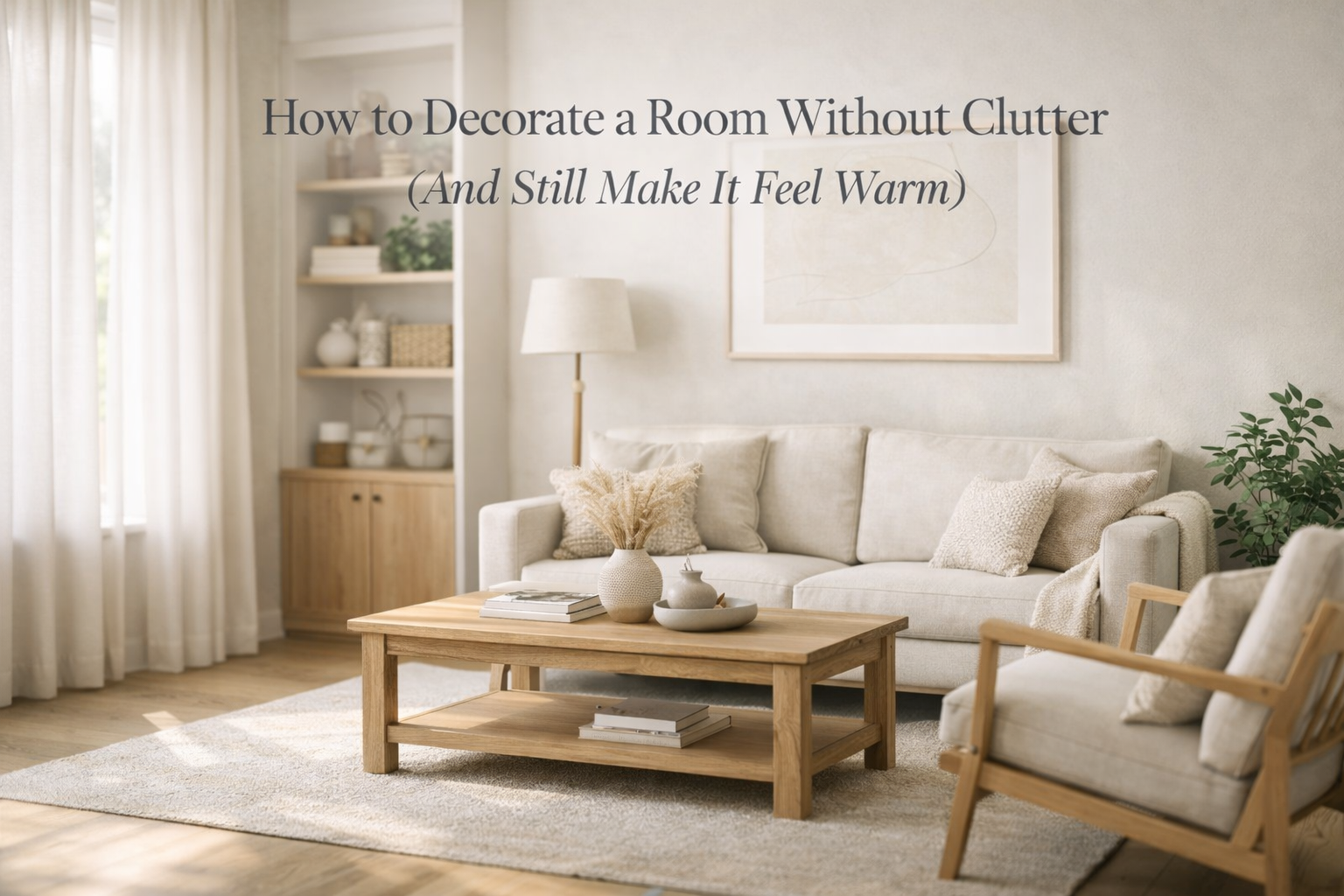
How to Decorate a Room Without Clutter (And Still Make It Feel Warm)
How to decorate a room without clutter is one of the most common interior design challenges, especially for people who want a home that feels cozy and personal without feeling visually overwhelming. Many homeowners worry that if they remove too much, the room will feel cold. Others fear that if they add decor, the space will feel messy.
The truth is that clutter and decoration are not the same thing. A home can have personality and warmth without being filled with random objects. The difference is intention. Decoration works when it has structure. Clutter happens when objects have no role or no place.
A well-decorated room feels calm because the eye knows where to rest. The furniture feels balanced, the surfaces are controlled, and the room has a clear identity. This is not about minimalism. It’s about design clarity.
In this guide, we’ll break down how to decorate a room without clutter while still creating warmth, texture, and a lived-in feeling that works in real homes.
Why Decor Often Turns Into Clutter
Decor becomes clutter when it lacks a framework.
Most cluttered rooms share the same issues:
- too many small decorative items
- too many competing colors and textures
- surfaces used for storage instead of styling
- no visual hierarchy
When everything is meant to be “a detail,” nothing becomes the main point. The room feels noisy.
This is why good decorating starts with understanding proportion and scale. If you want to create a cohesive look, our guide on furniture scale in real homes explains why balance matters more than quantity.
How to Decorate a Room Without Clutter by Using a Visual Hierarchy
A room needs hierarchy. This means some elements should dominate, and others should support.
Hierarchy can be created through:
- one main focal point (art, fireplace, window, sofa wall)
- one dominant texture (wood, fabric, stone)
- one dominant shape language (curves vs clean lines)
When hierarchy exists, you can add decor without chaos.
Without hierarchy, even small amounts of decor can feel messy because everything competes for attention.
This is one of the most important principles of how to decorate a room without clutter: the room needs a clear structure before you add details.
Control Surfaces First (Tables, Shelves, Consoles)
Most clutter is surface clutter.
Decorating without clutter requires treating surfaces like curated spaces, not storage.
A practical rule is the “two-thirds method”:
- use only about two-thirds of a surface for decor
- leave one-third empty
That empty space is not wasted. It creates breathing room. It makes the decor look intentional.
The easiest way to control surfaces is to use trays and containers. A tray turns random objects into a grouped composition.
This is closely connected to building routines that prevent clutter, which we explain in our guide on how to reduce clutter in living spaces.
Use Fewer, Larger Decorative Elements
Many people decorate with small objects because they are easy to buy. The problem is that small objects multiply quickly.
A better approach is fewer, larger pieces:
- one large vase instead of five small ones
- one statement artwork instead of multiple random prints
- one oversized bowl instead of many scattered accessories
Large pieces create impact without creating visual noise.
This is why many well-designed homes feel clean but still rich. They use scale strategically.
How to Decorate a Room Without Clutter Using Texture Instead of Objects
One of the best ways to create warmth is texture.
Texture adds depth without adding clutter.
Examples of texture-based decorating:
- layered textiles (throws, pillows)
- natural wood surfaces
- rugs with subtle pattern
- linen curtains
- matte ceramics
Texture is powerful because it creates atmosphere without requiring many objects.
This is also why furniture materials matter. A room with high-quality textures feels finished with fewer decorative additions.
If you want a deeper breakdown, our furniture materials comparison post explains why materials shape long-term satisfaction.
Keep Open Shelves Minimal and Structured
Open shelving is one of the biggest clutter traps.
Open shelves look great when curated, but in real homes they often become mixed storage.
If you want shelves without clutter:
- keep items grouped by category
- use negative space intentionally
- mix books with closed boxes
- avoid filling every shelf completely
Open shelving works best when it has rhythm.
If you want a deeper understanding of how storage affects design behavior, our guide on interior design and daily behavior explains why clutter forms even in beautiful homes.
Use Color Consistency to Reduce Visual Noise
Color is one of the fastest ways to create cohesion.
A cluttered room often has too many unrelated tones.
To decorate without clutter:
- keep walls neutral or consistent
- repeat the same accent color 2–3 times
- limit strong contrasts
This creates a calm visual base.
If you want a full framework for cohesion, our post on how to make a home feel cohesive explains how repetition and proportion create harmony without matching everything.
Let Furniture Be the Decor
The easiest way to avoid clutter is to treat furniture as the main design element.
A room with strong furniture doesn’t need excessive decor.
Good furniture design already includes:
- shape and proportion
- texture and material depth
- visual weight and balance
This is why furniture planning is part of decorating. If furniture is wrong, decor becomes an attempt to “fix” the room.
Our guide on how furniture fits real homes explains why furniture interaction matters more than isolated beauty.
FAQ
How do I decorate a room without clutter but still make it cozy?
Use texture (rugs, throws, curtains) and fewer larger decor pieces. Leave breathing room on surfaces so the room feels calm.
How many decorative items should a room have?
There is no fixed number, but fewer larger items usually look more intentional than many small ones.
Are open shelves always cluttered?
Not always, but they require structure. Use closed boxes and leave negative space to avoid visual overload.
How do I make decor look intentional?
Group items in trays, repeat colors and textures, and create a clear focal point.
Why does my decor always feel messy?
Often because there is no visual hierarchy and surfaces are being used as storage rather than styled zones.
Conclusion
Learning how to decorate a room without clutter is about structure, not restriction. A warm home doesn’t need dozens of objects. It needs balance, texture, and intentional placement. When surfaces are controlled, furniture is properly scaled, and decor supports the room’s hierarchy, the space feels calm, personal, and genuinely lived in without ever feeling messy.