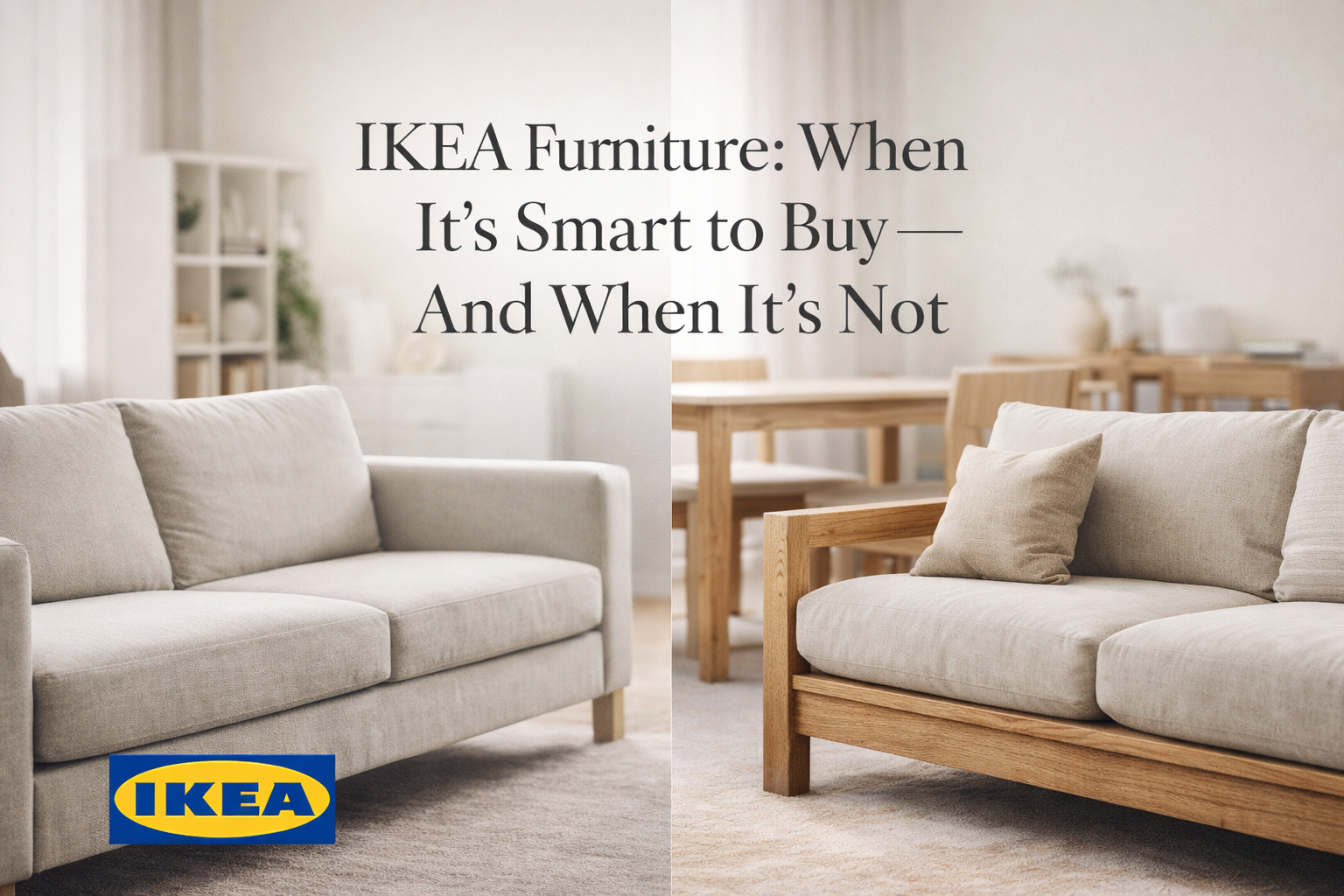
IKEA Furniture: When It’s Smart to Buy – And When It’s Not
IKEA furniture is often the first place people look when furnishing a home. It’s accessible, affordable, modern, and easy to transport. For many households, it feels like the obvious choice.
But here’s the real question:
Is IKEA furniture actually a smart long-term decision or just a short-term solution?
The answer isn’t extreme. It’s not “IKEA is bad” or “IKEA is perfect.” The truth depends entirely on what you’re buying, how you live, and how long you expect it to last.
If you approach it strategically, IKEA can be a smart tool.
If you approach it blindly, it can quietly cost you years.
Let’s break this down properly.
Why IKEA Furniture Is So Popular (And Why That Matters)
Before comparing durability or materials, we need to understand why IKEA dominates.
IKEA succeeds because it offers:
- Flat-pack transport
- Clean, neutral design
- Predictable pricing
- Immediate availability
- Modular systems
For renters, students, first apartments, or short-term living situations, that combination is powerful.
But popularity doesn’t automatically equal longevity.
And that’s where most mistakes begin.
When IKEA Furniture Is a Smart Buy
There are specific scenarios where IKEA furniture makes excellent sense.
1. Temporary Living Situations
If you’re:
- Renting
- Moving within 1–3 years
- Furnishing a starter apartment
- Creating a short-term guest room
Then long-term structural durability isn’t the top priority.
Spending 3x more on heirloom construction for a two-year setup doesn’t always make financial sense.
In this case, IKEA is efficient.
2. Storage Systems (Especially Modular Ones)
Certain IKEA categories perform very well relative to price.
Examples:
- Bookcases (like KALLAX style cube systems)
- Closet systems
- Modular wardrobes
- Wall shelving
These pieces work because:
- They’re vertically loaded (not impact heavy)
- They don’t endure constant stress
- They’re easy to reinforce or anchor
For organization and light daily use, IKEA performs well.
3. Low-Impact Furniture
Furniture that doesn’t experience:
- Heavy sitting pressure
- Structural torque
- Frequent moving
- Weight-bearing stress
Examples:
- Side tables
- Console tables
- Entry benches (light use)
- Nightstands
In these categories, the value-to-performance ratio is often reasonable.
4. Budget-Constrained Phases
Sometimes the correct decision isn’t about perfection it’s about reality.
If furnishing the entire home at once:
- Buying mid-tier everything may delay stability
- Strategic IKEA purchases can create breathing room
The key word is strategic.
Not default.
When IKEA Furniture Is Not a Smart Long-Term Investment
Now we move into the important part.
This is where many homeowners make quiet mistakes that compound over time.
1. Sofas and High-Use Seating
Sofas are structural pieces.
They endure:
- Daily compression
- Side loading
- Frame stress
- Movement
- Weight shifts
Many IKEA sofas use:
- Particleboard components
- Lightweight framing
- Staple-based construction
That doesn’t automatically mean “bad.”
But it often means shorter lifespan under heavy use.
If you live alone and sit lightly, it may last years.
If you have children, pets, guests durability changes dramatically.
For long-term seating decisions, understanding construction is critical.
(You can compare this with our deeper breakdown in How to Choose a Sofa That Lasts.)
2. Dining Tables for Daily Families
Dining tables handle:
- Weight
- Moisture
- Impacts
- Dragging chairs
- Heat exposure
Solid wood tables can be refinished.
Engineered or veneer-heavy tables often cannot.
This is where IKEA vs solid wood furniture becomes a real cost-over-time conversation.
3. Frequently Moved Furniture
Flat-pack design is efficient for transport.
But repeated disassembly and reassembly weakens:
- Screws
- Dowel joints
- Cam locks
- Particleboard cores
If you move often, ironically, flat-pack furniture can degrade faster than expected.
4. Long-Term “Forever Home” Planning
If your goal is:
- 10–20 year stability
- Structural longevity
- Refinishing capability
- Multi-generation durability
Then you must evaluate materials more deeply than surface design.
Aesthetic similarity does not equal structural similarity.
IKEA vs Solid Wood Furniture: What Actually Lasts Longer?
This comparison is often oversimplified.
Let’s clarify.
Solid Wood:
- Can be refinished
- Handles stress better
- Ages naturally
- More repairable
- Higher upfront cost
IKEA Engineered Construction:
- Lighter
- Lower cost
- Often veneer over composite
- Limited refinishing potential
- Designed for cost efficiency
Neither is “wrong.”
But they are not interchangeable.
If long-term adaptability matters to you, solid wood provides more margin for error.
Is IKEA Furniture Durable?
This is one of the most searched questions.
The honest answer:
It depends entirely on category and usage intensity.
Durable in:
- Light shelving
- Storage cubes
- Decorative units
- Low-impact rooms
Less durable in:
- High-traffic seating
- Heavy dining use
- Structural bed frames under stress
- Repeated relocation environments
Durability is contextual.
The Real Question: What Role Is the Piece Playing?
Instead of asking “Is IKEA good or bad?”, ask:
- Is this piece structural or cosmetic?
- Will this endure daily pressure?
- Am I planning to keep it 2 years or 15?
- Can it be repaired or refinished?
- Will it move houses with me?
Furniture planning is about systems, not individual items.
When Mixing IKEA With Higher-Quality Pieces Makes Sense
One of the smartest approaches isn’t all-or-nothing.
Consider:
- Invest in: sofa, dining table, bed frame
- Save on: shelving, side tables, secondary storage
- Upgrade gradually
This creates a stable structural foundation while controlling budget.
Furniture decisions compound over time.
Not everything needs to be premium but the wrong thing being cheap can cost you more.
How IKEA Furniture Fits Into Long-Term Planning
If you view IKEA as:
- A temporary solution
- A modular layer
- A budget bridge
- A design placeholder
It works beautifully.
If you view it as:
- Permanent heirloom replacement
- Structural anchor
- Multi-decade investment
You may be disappointed.
FAQ
Is IKEA furniture good quality?
IKEA furniture offers acceptable quality for light to moderate use, especially in storage and decorative categories. It is less durable in high-stress structural pieces like sofas and dining tables.
How long does IKEA furniture last?
With light use, IKEA furniture can last 5–10 years. Under heavy daily use, lifespan may be shorter depending on construction and materials.
Is IKEA furniture solid wood?
Some IKEA products include solid wood components, but many use engineered wood, particleboard, or veneer construction. Always check the product specifications.
Is IKEA furniture worth the money?
It can be worth the money when used strategically for temporary, modular, or low-impact furniture needs. For long-term structural pieces, investing in higher-grade materials may offer better value over time.
Final Thought
IKEA furniture is not the villain.
It’s not the hero either.
It’s a tool.
Used intentionally, it supports your home.
Used automatically, it can create hidden replacements down the line.
The smartest homes aren’t furnished by brand loyalty.
They’re furnished by understanding:
- Use patterns
- Material behavior
- Structural stress
- Long-term adaptability
And that’s where furniture planning becomes powerful.