
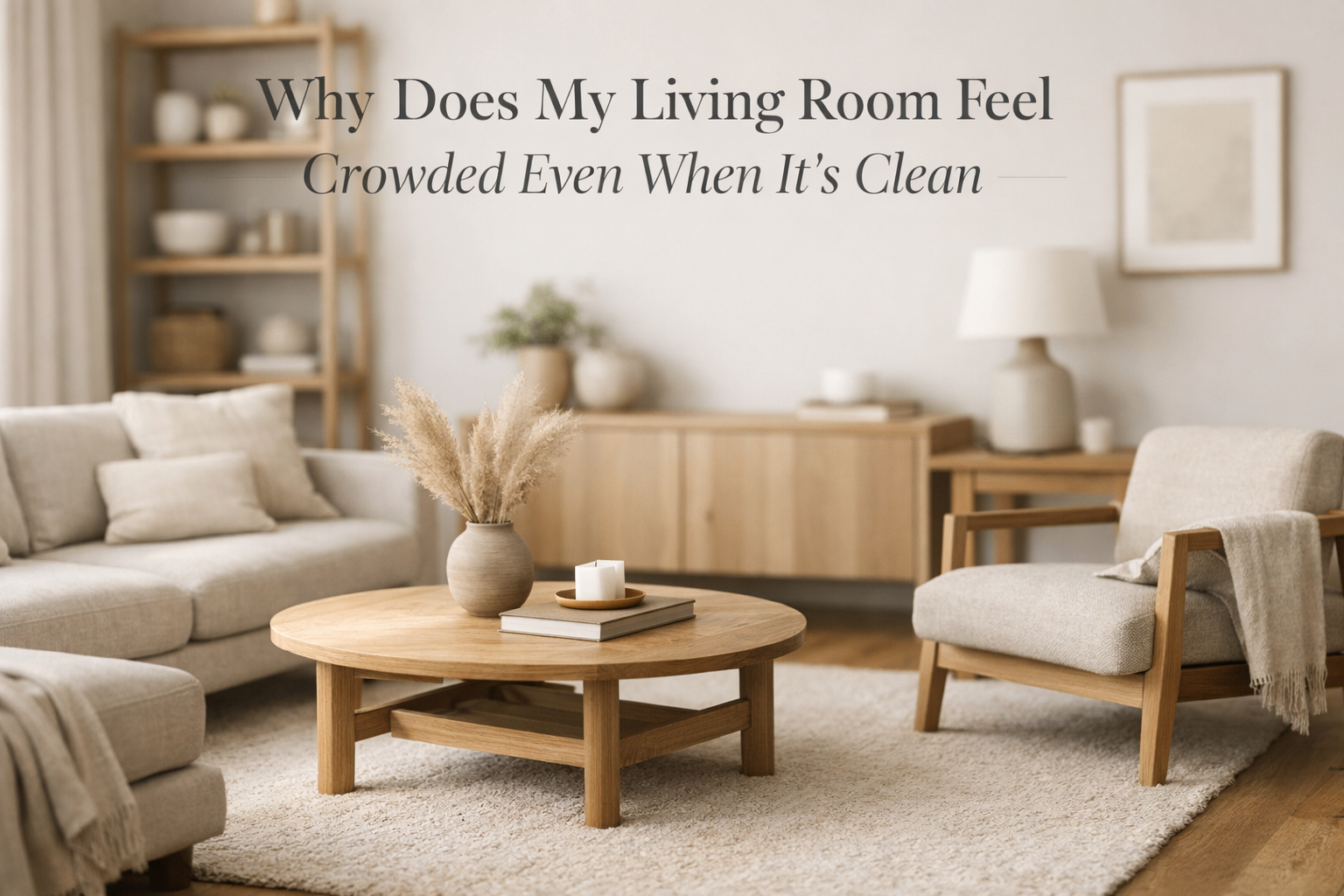
Why Does My Living Room Feel Crowded Even When It’s Clean
Why does my living room feel crowded is a question many homeowners ask after they have already decluttered, cleaned, and simplified the space. The floors are clear. The surfaces are tidy. Nothing appears chaotic. Yet the room still feels tight, heavy, or uncomfortable.
The frustration usually comes from confusion. If the room is clean, why does it still feel cramped?
The answer is rarely about clutter alone. Most crowded living rooms are suffering from proportion issues, layout interruptions, visual blockages, or scale mismatches. Cleanliness does not automatically create spatial balance.
In this guide, we will break down the real reasons a living room feels crowded and how to correct them without knocking down walls or buying an entirely new set of furniture.
The Furniture Is Too Large for the Room’s Proportions
One of the most common reasons people ask why does my living room feel crowded is oversized furniture.
Large sectionals, deep sofas, bulky recliners, and wide entertainment units dominate visual space. Even if there are only a few pieces, their scale may be wrong for the room’s dimensions.
The issue is not quantity. It is proportion.
When furniture visually fills too much vertical or horizontal space, the eye has no breathing room. Circulation paths shrink. Corners become blocked. The room feels compressed.
This is why understanding furniture scale and proportion is essential before purchasing major pieces. A sofa that looks balanced in a showroom may overwhelm a smaller home.
Furniture Placement Is Blocking Natural Flow
Even properly sized furniture can create crowding if the layout interrupts movement.
Common layout mistakes include:
Pushing all furniture against walls
Placing large pieces directly in entry paths
Blocking window light with tall furniture
Creating tight walkways between seating
A room needs clear circulation routes. If movement feels restricted, the brain interprets the space as smaller than it is.
Living room layout should prioritize flow first and symmetry second. A room that allows easy movement always feels larger.
Too Many Visual Anchors Compete for Attention
Another overlooked reason why does my living room feel crowded is visual competition.
When multiple elements fight to become the focal point, the room feels chaotic even if it is clean.
Examples include:
bold artwork on several walls
a strong patterned rug combined with patterned upholstery
a large TV wall competing with a statement fireplace
multiple contrasting wood tones
When everything demands attention, nothing feels grounded.
A room needs one dominant anchor. The rest should support it. Without hierarchy, even minimal decor can feel overwhelming.
The Rug Is Too Small
An undersized rug can make a living room feel fragmented.
When a rug floats in the center without connecting furniture, seating appears disconnected. The eye reads the room as several small islands rather than one cohesive space.
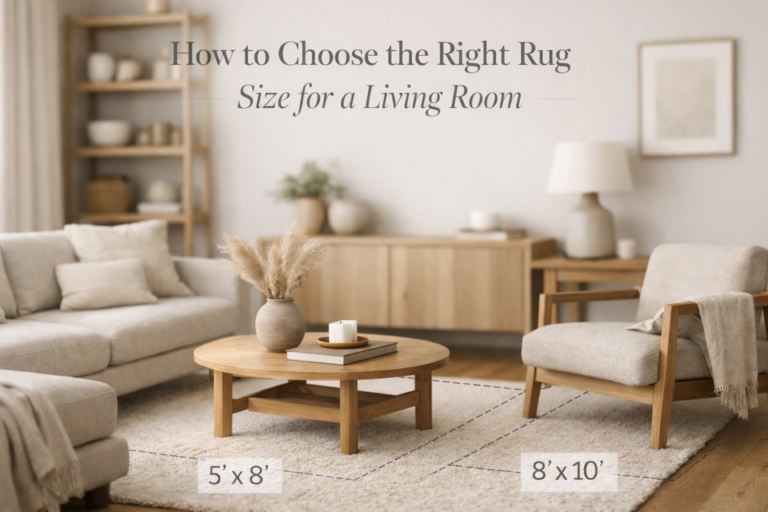
Proper rug sizing helps unify furniture. Ideally, at least the front legs of major seating pieces should rest on the rug.
Small design miscalculations like this often create disproportionate visual tension.
Heavy Window Treatments Reduce Light
Natural light expands perceived space. Heavy drapes, dark curtains, or improperly mounted curtain rods can reduce that effect.
Curtains mounted too low visually shorten walls. Thick fabrics block brightness. Dark window treatments absorb light rather than reflect it.
If the room already feels tight, light management becomes critical.
Mounting curtain rods higher and choosing lighter fabrics can immediately reduce visual weight.
Furniture Depth Is Eating Floor Space
Deep sofas are comfortable, but they require room.
A sofa that is 100 cm deep in a narrow living room consumes walking space. The remaining pathway may technically meet minimum clearance, but visually it feels narrow.
When multiple deep pieces face each other, the center walkway shrinks even further.
In smaller rooms, slightly shallower furniture often feels more balanced while still providing comfort.
Too Many Small Decorative Objects
Clutter is not only about mess. It can be about fragmentation.
Many small decorative items scattered across shelves, consoles, and coffee tables create visual noise. Even when organized, they divide attention into tiny focal points.
Fewer, larger decorative elements create calmer visual rhythm.
This connects closely to understanding how to decorate a room without clutter, where scale and restraint matter more than quantity.
Wall Color and Contrast Are Shrinking the Room
Strong color contrast between walls, trim, and furniture can visually cut up space.
Very dark accent walls combined with lighter surrounding walls sometimes reduce perceived width.
Sharp horizontal contrasts across a room create visual segmentation rather than continuity.
Soft tonal transitions usually feel more expansive.
The Ceiling Feels Low Because of Visual Weight
Low-hanging lighting fixtures, dark ceiling paint, or heavy crown molding can compress vertical perception.
If the room feels crowded from above, not just from the sides, vertical visual weight may be the cause.
Lighter ceiling colors, slimmer lighting fixtures, and upward-facing lamps can restore vertical balance.
The Room Lacks Negative Space
Negative space is intentional emptiness. It allows the eye to rest.
When every wall has decor and every corner has furniture, the room feels saturated.
Leaving certain areas intentionally open does not make a room incomplete. It makes it breathable.
Understanding how to design a room layout that feels natural and functional helps identify where space should remain open rather than filled.
FAQ
Why does my living room feel crowded even though it’s tidy?
Because crowding is usually caused by proportion, scale, and layout issues rather than surface clutter.
Can I fix a crowded living room without buying new furniture?
Often yes. Adjusting layout, removing one oversized piece, improving lighting, or resizing the rug can significantly improve perception.
Is pushing furniture against walls the best way to make space?
Not always. Sometimes floating furniture slightly away from walls creates better flow and balance.
How much walking space should a living room have?
Clear pathways of about 75 to 90 cm generally feel comfortable without appearing tight.
Does lighter color automatically make a room look bigger?
Not automatically. Light helps, but layout and proportion have a stronger impact.
Conclusion
If you have ever asked yourself why does my living room feel crowded, the answer is rarely about cleanliness alone. Crowding is usually a structural design issue, not a housekeeping problem.
When furniture scale aligns with room dimensions, circulation paths are clear, visual hierarchy is established, and negative space is respected, the same square footage can feel dramatically different.
A living room does not need to be large to feel open. It needs to be intentional.
One Comment