
Coffee Table Distance From Sofa: What Actually Works
Coffee table distance from sofa is one of those small layout details that quietly determines whether a living room feels comfortable or awkward. Many people place a coffee table based on guesswork. The result is often either cramped movement or an unreachable surface.
The correct spacing between a sofa and a coffee table affects walking flow, legroom, posture, and overall balance. Even a well-designed room can feel slightly “off” if this distance is wrong.
In this guide, we will break down the practical rules behind coffee table distance from sofa and explain how to adjust spacing based on room size, furniture scale, and everyday use.
The Standard Distance Rule
In most living rooms, the ideal coffee table distance from sofa is between 40 and 45 cm.
This range allows:
• enough legroom for seated comfort
• easy reach to place drinks or books
• smooth walking circulation
Less than 35 cm usually feels cramped.
More than 50 cm often makes the table feel disconnected and impractical.
The goal is accessibility without restriction.
Why This Distance Matters More Than You Think
The spacing between sofa and table determines how natural the room feels during daily use.
If the table is too close:
• knees constantly hit the edge
• standing up feels restricted
• movement feels tight
If the table is too far:
• you lean forward awkwardly
• the seating area feels visually fragmented
• the table appears like a floating island
Small measurement differences create noticeable comfort differences over time.
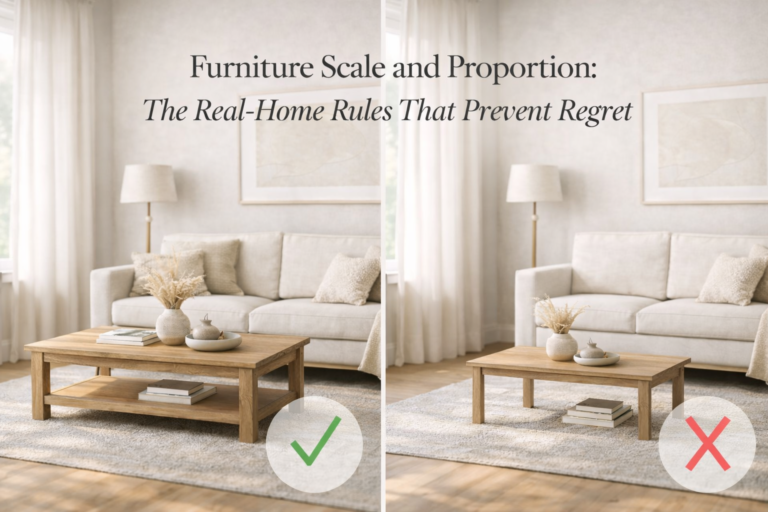
This connects directly to proportion principles explained in Furniture Scale and Proportion: The Real-Home Rules That Prevent Regret, where spacing influences how furniture interacts within a room.
Adjusting Distance for Deep Sofas
Not all sofas are equal.
Modern deep sofas may extend 100 cm or more in depth. When cushions are thick and seats are deep, the visual front edge shifts slightly.
In those cases, maintaining the standard 40 to 45 cm from the actual seat edge, not the sofa frame, ensures comfortable reach.
Deep sofas often require slightly narrower coffee tables to preserve walking paths.
If your room already feels tight, this may be part of the issue described in Why Does My Living Room Feel Crowded Even When It’s Clean.

Small Living Rooms Require Precision
In compact spaces, every centimeter matters.
If walkways are limited, you may need to reduce coffee table width instead of reducing the distance.
Never sacrifice comfortable seating access just to maintain a larger table.
If space is truly constrained, consider:
• oval coffee tables
• round tables
• nesting tables
Rounded edges improve flow and reduce visual bulk.
Understanding how to design a room layout that feels natural and functional helps clarify where space should remain open instead of filled.
Coffee Table Height and Its Relationship to Distance
Distance is only half of the equation. Height matters too.
A coffee table should generally be:
• equal to sofa seat height
or
• 2 to 5 cm lower
If the table is too high, it feels intrusive.
If too low, it feels disconnected.
Proper height reinforces comfortable spacing. Together, height and distance determine usability.
When a Larger Distance Works
There are exceptions.
In very large living rooms where seating pieces are deeper and circulation zones are generous, spacing can extend to 50 cm.
However, once you exceed that range, the coffee table may no longer function as a central anchor.
If you notice the table becoming decorative rather than practical, the spacing is likely too wide.
Alternative Layouts Without a Traditional Coffee Table
Some layouts function better without a central coffee table.
Alternatives include:
• side tables beside each seat
• C-shaped tables
• storage ottomans
This approach works especially well in smaller spaces or flexible seating arrangements.
If your seating configuration is unconventional, reviewing guidance in How to Arrange Furniture in a Living Room for Comfort and Flow can clarify whether a central table is even necessary.
Visual Balance and Negative Space
Coffee tables also influence how heavy the room feels.
A bulky table in a tight room reduces negative space. Even if distance is technically correct, the visual weight may create compression.
Glass, lighter wood tones, or open-frame tables can reduce that effect.
If the room already struggles with density, adjusting table material may improve perception without changing measurements.
Testing Before Final Placement
Before committing:
- Place the coffee table in position
- Sit down and stand up multiple times
- Walk around the seating area
- Test reaching for objects
Movement reveals spacing errors faster than visual inspection.
Living rooms are used daily. Comfort must guide decisions more than symmetry.
FAQ
What is the ideal coffee table distance from sofa?
Between 40 and 45 cm is ideal for most living rooms.
Can the distance be smaller in tight spaces?
It can be slightly reduced, but below 35 cm usually feels cramped.
How far is too far?
More than 50 cm often makes the table difficult to reach and visually disconnected.
Should the coffee table be centered exactly?
Generally yes, but alignment should follow the seating arrangement rather than the room’s walls.
What if my sofa is very deep?
Measure from the front of the seat cushion, not the back frame.
Conclusion
Coffee table distance from sofa may seem like a minor detail, but it shapes comfort, usability, and visual balance.
When spacing falls within a functional range and aligns with furniture scale, the entire living room feels more intentional. Small measurement corrections often create noticeable improvements in how a space functions day to day.
Good layout is not about decoration. It is about interaction.