Why Does My Room Feel Unfinished Even With Furniture
Why does my room feel unfinished is a surprisingly common question homeowners ask after furnishing a space. The sofa is in place. The rug is down. Lighting works. Yet something still feels incomplete.
The room may technically be finished, but visually it lacks cohesion. Many interiors feel this way because furniture alone does not create a complete environment. Structure, proportion, lighting, and visual balance must work together.
An unfinished feeling usually comes from subtle design gaps rather than missing furniture.
Understanding these gaps makes it possible to fix the problem without replacing everything in the room.
The Rug Is Too Small for the Seating Area
One of the most common reasons a room feels unfinished is an undersized rug.
A rug that only sits under the coffee table leaves furniture visually disconnected. Sofas and chairs appear to float independently rather than forming a cohesive seating area.
A properly sized rug should anchor the seating zone and connect the major pieces of furniture.
This issue often relates directly to How to Choose the Right Rug Size for a Living Room, where rug dimensions determine whether a layout feels unified or fragmented.
When the rug anchors the layout correctly, the room instantly feels more structured.
The Walls Are Empty or Unbalanced
Rooms often feel incomplete when wall space is ignored.
Large empty walls can create visual imbalance, especially when furniture occupies only the lower portion of the room.
Artwork helps bridge the vertical gap between furniture and ceiling height.
Strategic placement matters more than quantity. Poor placement can look just as unfinished as empty walls.
Understanding Where to Place Wall Art for Proper Proportion helps ensure that wall decor reinforces the room’s structure instead of feeling random.

Lighting Is Too Limited
Lighting is one of the most overlooked design elements.
Many rooms rely on a single ceiling fixture. While it provides basic illumination, it rarely creates atmosphere.
Well-balanced rooms usually include multiple lighting layers:
• ambient lighting for general brightness
• task lighting for specific activities
• accent lighting for depth and warmth
Without layered lighting, the room can feel flat and incomplete even when furniture and decor are present.
Lighting creates dimension that furniture alone cannot provide.
Furniture Scale Is Slightly Off
Rooms often feel unfinished when furniture proportions are inconsistent.
For example:
• a large sofa paired with a tiny coffee table
• oversized chairs next to a narrow console
• small artwork above a large sofa
These mismatches create subtle imbalance.
Even when individual pieces are attractive, the overall composition feels unresolved.
This problem is closely related to Furniture Scale and Proportion: The Real-Home Rules That Prevent Regret, where the relationship between objects determines how finished a room appears.
Correct scale creates harmony without adding more items.
The Room Lacks a Clear Focal Point
Every room benefits from a focal point.
Without one, the eye does not know where to rest. The space feels scattered rather than intentional.
Common focal points include:
• a fireplace
• a television wall
• a large artwork
• a statement piece of furniture
Supporting elements should guide attention toward that focal area rather than competing with it.
A room with multiple competing focal points often feels chaotic rather than finished.
Decorative Elements Are Missing Texture
Decoration is not only about objects. Texture plays an important role.
Soft materials such as rugs, curtains, throws, and cushions introduce warmth and depth.
Rooms built entirely from hard surfaces like wood, metal, and glass often feel cold or incomplete.
Texture balances those materials and softens the environment.
Even a few textile elements can dramatically change how finished a room feels.
Layout Does Not Support Natural Movement
Sometimes a room feels unfinished because the layout itself feels awkward.
If walking paths are unclear or furniture blocks movement, the space never feels comfortable.
Layout problems often become visible only after living in the room for some time.
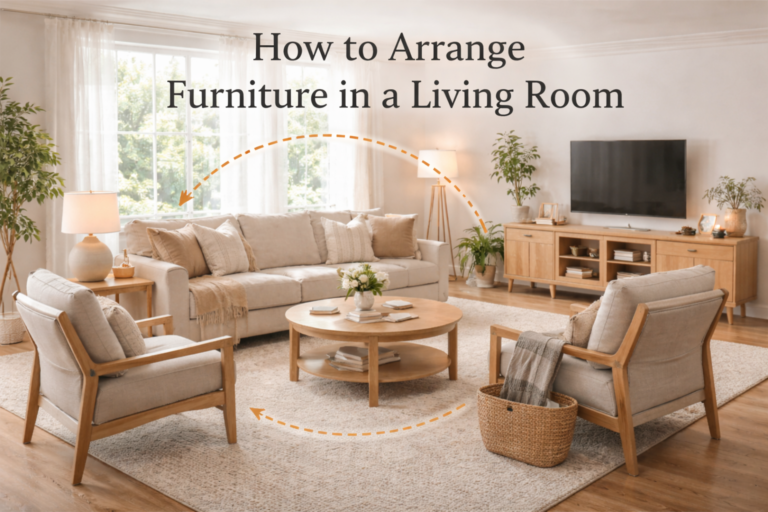
This issue is often solved by revisiting How to Arrange Furniture in a Living Room for Comfort and Flow, where circulation and seating relationships determine how natural a space feels.
Good layout creates invisible structure that makes the room feel complete.
Color Distribution Is Uneven
Another subtle reason rooms feel unfinished is uneven color distribution.
For example:
• one bold color appears only once
• dark furniture is concentrated on one side
• accents are scattered randomly
Repeating colors and tones across different parts of the room helps create visual continuity.
Consistency creates cohesion.
When colors appear intentionally throughout the space, the room feels unified rather than incomplete.
The Ceiling Area Is Ignored
Many interiors focus heavily on furniture and walls while ignoring the upper part of the room.
Ceiling lighting, pendant fixtures, or subtle architectural details help connect the vertical dimension of the space.
When the ceiling area is visually empty, the room can feel top-heavy or incomplete.
Vertical balance strengthens overall proportion.
Small Adjustments Often Solve the Problem
The encouraging part is that unfinished rooms rarely require major redesign.
Often the solution involves:
• adjusting rug size
• repositioning artwork
• improving lighting
• balancing furniture scale
• clarifying the focal point
These adjustments refine the structure that already exists.
Interior design is often about alignment rather than addition.
FAQ
Why does my room feel unfinished even with furniture?
Usually because of proportion issues, missing wall elements, poor lighting, or an unclear focal point.
Can lighting make a room feel unfinished?
Yes. Rooms with only one light source often feel flat and incomplete.
Do I need more furniture to fix the problem?
Not necessarily. Many unfinished rooms simply need better layout balance or wall elements.
Does artwork really matter that much?
Artwork connects vertical space with furniture and helps complete the visual structure of a room.
How can I quickly improve an unfinished room?
Start by evaluating rug size, wall art placement, lighting layers, and furniture proportions.
Conclusion
When people ask why does my room feel unfinished, the answer usually lies in subtle design relationships rather than missing furniture. Layout structure, wall balance, lighting layers, and correct proportion all contribute to a sense of completion.
Once these elements align, the same furniture can suddenly feel intentional, balanced, and fully integrated into the space.