How to Choose Furniture That Lasts: A Practical Long-Term Approach
How to choose furniture that lasts is one of the most important questions homeowners ask, yet it is rarely answered in a way that feels truly practical. Many guides focus on materials alone, or they simplify the decision into labels like “solid wood” or “high quality craftsmanship.” While those details matter, they don’t fully explain why some furniture remains satisfying for ten years while other pieces feel outdated or inconvenient after just one.
The reality is that durability is only part of the equation. Furniture longevity depends on how well a piece supports daily life: how it feels, how it fits, and how it handles the repeated small stresses that happen in every home. A table can be made of strong materials and still become annoying to use if it disrupts movement. A sofa can be expensive and still fail if its proportions don’t match the way people actually sit.
When you approach furniture as a long-term investment in comfort and function, the decision-making process becomes clearer. You stop shopping for “impressive” pieces and start choosing furniture that quietly performs.
This article is a practical guide to understanding how to choose furniture that lasts not just physically, but emotionally and functionally as well.
Why “Lasting Furniture” Is More Than Just Durability
Durability is easy to imagine. You picture a sturdy frame, a thick tabletop, or a finish that resists scratches. But lasting furniture is not only furniture that survives. It is furniture that stays relevant and enjoyable to use.
A piece can be perfectly intact and still fail in long-term value. It might feel uncomfortable, look out of place as your space evolves, or become impractical once your lifestyle changes. This is why how to choose furniture that lasts requires thinking beyond construction.
Long-lasting furniture has three essential qualities:
- structural reliability
- proportion and usability
- material aging that feels natural rather than disappointing
These qualities work together. If one is missing, the furniture may still last physically, but it will not last as a preferred part of your home.
How to Choose Furniture That Lasts by Prioritizing Structure First
Structure is the foundation of furniture longevity. If the structure is weak, everything else becomes irrelevant.
The structural components that matter most are usually invisible:
- frame joints
- internal supports
- load-bearing points
- fasteners and assembly method
Furniture built for longevity often uses joinery and reinforcement that prevent gradual loosening. In contrast, furniture that relies heavily on thin connectors or lightweight framing may feel stable at first but degrade slowly.
A key part of how to choose furniture that lasts is understanding that furniture should feel stable under real use. A dining chair should not flex excessively. A sofa should not creak when weight shifts. A table should feel balanced even if pressure is applied unevenly.
Structural integrity is especially important for furniture used daily, such as seating and tables. Decorative furniture can tolerate lighter construction because it carries less stress.
Proportion and Fit Are Often the Real Reason Furniture Gets Replaced
Many people replace furniture not because it breaks, but because it no longer feels right in the space.
This usually happens because of proportion. Furniture can technically fit a room and still be poorly scaled. A sofa may fit the wall but feel too deep for the room’s circulation. A table may fit the dining area but restrict movement around it. A bed may be the correct size but dominate the room visually.
This is why proportion is one of the most overlooked aspects of how to choose furniture that lasts.
Good proportion supports movement and balance. It allows furniture to remain functional even if the room layout changes. Poor proportion locks the room into one rigid arrangement, which makes the furniture feel limiting over time.
If you want furniture that lasts, choose pieces that allow flexibility.
Related reading:
https://furnituretraditions.net/furniture-proportions-in-real-homes
https://furnituretraditions.net/furniture-scale-in-real-homes
Comfort Determines Whether Furniture Lasts Emotionally
Comfort is not just a luxury feature. It determines whether furniture remains a natural part of daily life.
If a sofa looks beautiful but doesn’t support the body, it will eventually become a decorative object rather than a functional one. If dining chairs feel uncomfortable, meals become shorter and the space loses value. If a desk chair causes fatigue, productivity suffers.
Over time, discomfort becomes amplified. The more you use a piece, the more its flaws become noticeable. This is why comfort is central to how to choose furniture that lasts.
Comfort is influenced by:
- seat height
- seat depth
- back angle
- cushion density
- armrest placement
- overall ergonomics
Comfort also depends on how furniture matches your body and your habits. A chair that is comfortable for one person may not work for another. This is why it helps to evaluate furniture in the way you actually use it: leaning back, sitting upright, crossing legs, or shifting position.
Comfort is rarely judged correctly in a showroom because showroom visits are short. The real test happens after weeks of use.
Related reading:
https://furnituretraditions.net/furniture-usability-over-time
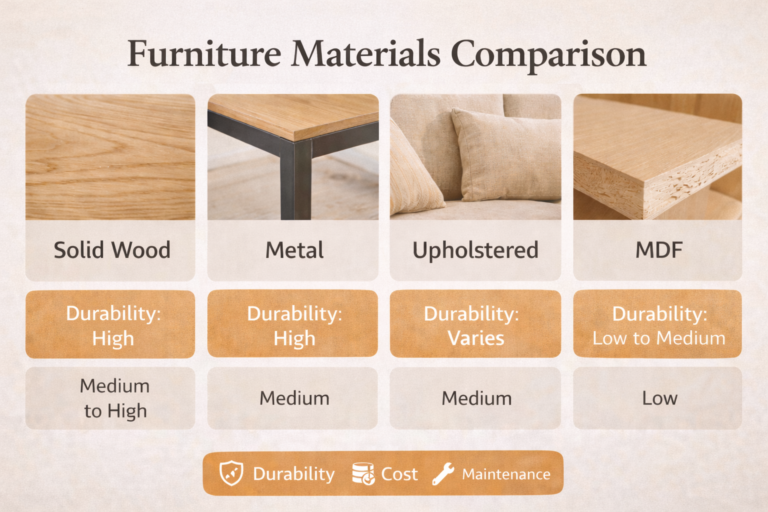
Materials That Age Gracefully Are More Valuable Than Perfect Surfaces
Furniture does not remain unchanged. It responds to light, touch, and time.
This is why material selection matters. Some materials develop character. Others develop disappointment.
For example:
- wood often gains warmth and patina
- leather may soften and deepen in tone
- some fabrics fade unevenly
- low-quality finishes can peel or dull quickly
A major part of how to choose furniture that lasts is choosing materials that become better—or at least acceptable—over time.
The best furniture materials are not those that resist change completely, but those that change in a way that feels natural. A table that develops subtle wear can feel authentic. A sofa that relaxes slightly can feel more comfortable. But cheap veneer that chips or fabric that pills aggressively will quickly reduce satisfaction.
Understanding how materials behave helps avoid frustration later.
Related reading:
https://furnituretraditions.net/how-furniture-ages-in-real-homes
How to Choose Furniture That Lasts by Thinking About Daily Behavior
Furniture exists inside routines. People move, sit, store, work, and relax. Furniture that supports these behaviors lasts longer because it remains useful.
One of the simplest questions you can ask is:
“What will this furniture piece be used for every day?”
This question reveals whether you are buying furniture for appearance or for function.
For example:
- If your dining table will be used for working, choose a surface that tolerates repeated contact.
- If your sofa is where you unwind daily, prioritize comfort and support over design trends.
- If your entryway storage is where clutter accumulates, choose accessible, forgiving solutions rather than fragile styling pieces.
When you understand your behavior, how to choose furniture that lasts becomes less about shopping and more about planning.
This behavioral approach is also why furniture that feels neutral often lasts longer. It adapts to evolving routines rather than forcing a specific lifestyle.
Adaptability Is a Hidden Factor in Long-Term Furniture Value
The homes that feel most stable are often the ones where furniture can move and adjust without breaking the design.
Adaptable furniture lasts because it remains relevant. It can shift between rooms, support changing layouts, or take on new functions as life changes.
Examples of adaptable furniture include:
- modular seating
- side tables that can be repositioned easily
- storage pieces with flexible shelving
- dining chairs that work in multiple rooms
Adaptability is an important factor in how to choose furniture that lasts because it protects your investment. Even if you change your interior style later, adaptable furniture can remain part of the space.
Rigid, highly specific furniture often becomes outdated simply because it cannot evolve.
Why Long-Term Furniture Satisfaction Comes From Quiet Performance
Many people assume long-lasting furniture must be visually dramatic. In reality, the furniture people keep the longest is often the furniture that works quietly.
A piece that performs well does not create daily friction. It does not demand constant adjustment. It does not require the room to be arranged around it. It supports routines naturally.
This is why the most important part of how to choose furniture that lasts is not the design label or the trend. It is the interaction between the furniture and daily life.
Furniture that supports everyday living becomes a background element of comfort, which is often the highest form of success.
Related reading:
https://furnituretraditions.net/how-furniture-supports-everyday-living
Conclusion
Choosing furniture that lasts is not about chasing perfect materials or expensive labels. It is about choosing pieces that support daily routines, adapt to change, and remain comfortable over time.
When you understand how to choose furniture that lasts, you begin to prioritize structure, proportion, comfort, and material behavior. These are the factors that determine whether furniture becomes a long-term asset or a short-term regret.
Furniture should not just survive. It should continue to feel right.
FAQ
How do I know if furniture will last long term?
Look for structural stability, balanced proportions, and materials that age gracefully under regular use.
Is expensive furniture always longer lasting?
Not always. Price does not guarantee comfort, usability, or proportion. Some expensive pieces are designed for appearance rather than daily life.
What matters more: material or design?
Both matter, but design and proportion often determine whether furniture remains usable, while materials determine how it ages.
Why do people replace furniture even when it isn’t broken?
Because it becomes uncomfortable, impractical, or visually incompatible with the space over time.