Dining Table Size Guide for Different Room Sizes
Dining table size guide searches usually begin after a mistake has already happened. The table looked perfect in the store. It matched the style. The material felt right. But once placed at home, the room feels tight, circulation is awkward, and chairs are difficult to move.
Dining tables are central pieces of furniture. When sizing is wrong, the entire room feels uncomfortable.
Choosing the correct dimensions is not about aesthetics first. It is about proportion, clearance, and daily function.
In this dining table size guide, we will break down exact spacing rules, practical measurements, and how to match table dimensions to different room sizes.
The Minimum Clearance Rule
The most important measurement in any dining table size guide is clearance.
You should have at least 90 cm of space between the edge of the table and the nearest wall or furniture.
This allows:
• chairs to be pulled out comfortably
• people to pass behind seated guests
• natural movement without friction
In tighter spaces, 75 cm can function as an absolute minimum, but it will feel compact.
Less than that usually creates daily frustration.
Clearance determines comfort more than table length.
Standard Dining Table Dimensions
Understanding typical table sizes helps avoid proportion mistakes.
Common rectangular table sizes:
• 120 cm length seats 4
• 150 to 160 cm length seats 6
• 180 to 200 cm length seats 6 to 8
• 220 cm and above seats 8 to 10
Standard width is usually between 80 and 100 cm.
Round tables:
• 90 to 100 cm diameter seats 4
• 120 cm diameter seats 6
• 150 cm diameter seats 8
But room size must support these numbers.
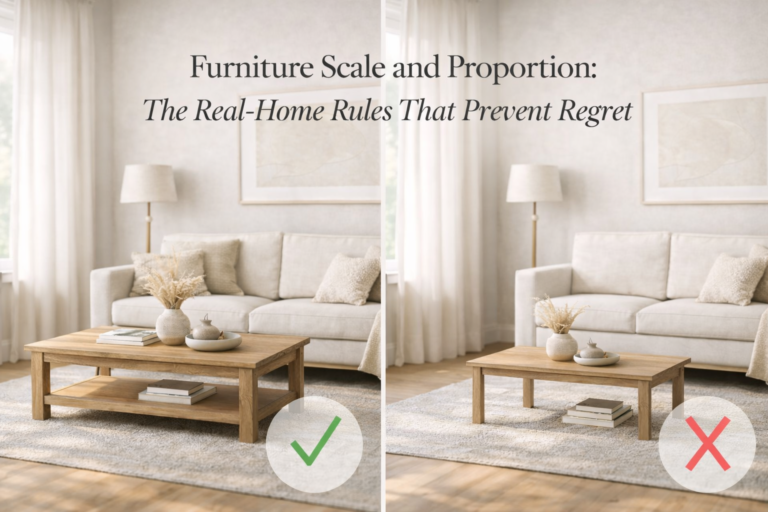
This relates directly to Furniture Scale and Proportion: The Real-Home Rules That Prevent Regret, where measurement must match environment rather than expectation.
Small Dining Areas
In smaller dining rooms or open-plan apartments, precision matters.
For compact areas:
• consider round tables to improve flow
• avoid thick pedestal bases that consume leg space
• keep table width closer to 80 cm
If space is limited, prioritize clearance over maximum seating capacity.
Forcing a large table into a tight area often creates the same compression described in Why Does My Living Room Feel Crowded Even When It’s Clean, where proportion errors reduce comfort.
Medium-Sized Dining Rooms
In average-sized dining rooms, 150 to 180 cm rectangular tables often work well.
This size accommodates families comfortably without overwhelming the space.
Ensure 90 cm clearance on all sides whenever possible.
Lighting placement also matters. A centered pendant above the table reinforces proportion and balance.
If layout feels slightly awkward, revisiting principles in How to Design a Room Layout That Feels Natural and Functional can help correct spatial relationships.
Large Dining Rooms
In spacious rooms, undersized tables can look disconnected.
A small table floating in a large dining room creates imbalance.
In larger spaces:
• increase table length
• consider thicker table tops
• use wider proportions
Visual weight must match room scale.
However, do not exceed comfortable reach. Extremely wide tables reduce conversation comfort.
Chair Spacing and Elbow Room
Each diner typically needs 55 to 60 cm of width along the table edge.
For example:
A 180 cm table comfortably seats 3 people per side.
Overcrowding chairs reduces both comfort and aesthetics.
Armchairs require additional space. If using them at table ends, account for extra width.
Proper spacing enhances both visual rhythm and usability.
Table Height and Comfort
Standard dining table height ranges between 74 and 76 cm.
Chair seat height should allow 25 to 30 cm between seat and tabletop.
If the height relationship is wrong, comfort decreases even if table size is correct.
Dining comfort is a measurement issue, not just a style decision.
Rectangular vs Round Tables
Shape influences perception.
Rectangular tables:
• work best in rectangular rooms
• align with architectural lines
• maximize seating capacity
Round tables:
• improve flow in compact spaces
• eliminate sharp corners
• create balanced conversation zones
Choosing the right shape can make a small room feel more functional without changing square footage.
Open Concept Considerations
In open-plan layouts, dining tables must balance with adjacent living areas.
The table should not visually overpower nearby seating.
If the dining area connects to the living room, spacing and scale should align with furniture choices discussed in Home Furniture Planning Guide: How to Build a Space That Works Long Term.
Continuity between zones strengthens cohesion.
Testing Layout Before Purchase
Before committing:
- Mark table dimensions on the floor with tape
- Place chairs inside that boundary
- Walk around the perimeter
- Simulate seating and movement
This practical test reveals clearance problems immediately.
Dining tables are daily-use infrastructure. Guesswork creates long-term discomfort.
FAQ
How much space should be around a dining table?
Ideally 90 cm on all sides for comfortable movement.
What size dining table fits in a small room?
Tables around 120 to 150 cm length usually fit well in compact spaces, depending on clearance.
How many people fit at a 180 cm table?
Typically 6 comfortably, sometimes 8 if space allows.
Is a round table better for small rooms?
Often yes, because it improves flow and eliminates corners.
Can a dining table be too big?
Yes. If clearance is reduced below comfortable movement, the room will feel cramped.
Conclusion
A proper dining table size guide focuses first on clearance, then on seating capacity, and finally on aesthetics.
When dimensions align with room scale and movement patterns, the dining area feels natural and functional. Choosing the correct size is not about maximizing seats. It is about protecting comfort and proportion for daily life.