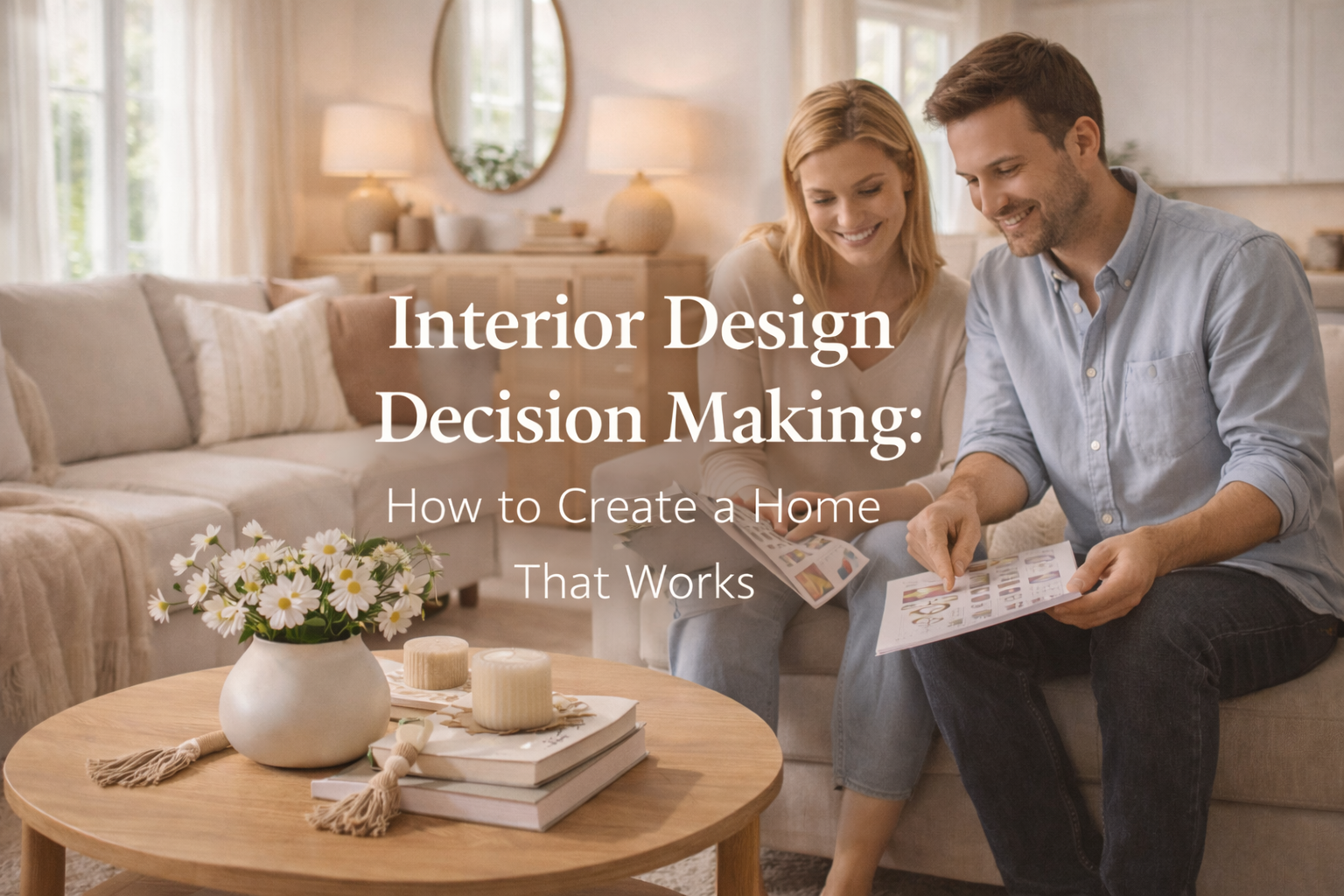
Interior Design Decision Making: How to Create a Home That Works
Interior design decision making is one of the most underestimated challenges in creating a comfortable home. People often assume that good design is a matter of taste or having the right inspiration. In reality, most frustration in interiors comes from decision fatigue: too many options, too many opinions, and no clear framework for choosing what actually works.
This is why many homes end up looking unfinished or inconsistent, even when the individual pieces are attractive. The problem is rarely the furniture or the paint color. The problem is that decisions are made in isolation rather than as part of a functional system.
Interior design is not simply decorating. It is the process of organizing space so daily life feels easier. Once you view design as an ongoing series of decisions rather than a single makeover, the entire process becomes clearer, more intentional, and far less stressful.
Why Interior Design Decisions Feel Harder Than They Should
One reason interior design feels overwhelming is that it combines emotional and practical factors. People want comfort, beauty, and identity in their space. At the same time, they need storage, movement, lighting, and flexibility.
Most people begin with a mental image of what they want. They save photos, browse Pinterest boards, and imagine a final result. But when they start making actual purchases, reality introduces limitations: budgets, room proportions, and the fact that daily life is rarely as clean as a showroom.
This is where interior design decision making becomes complicated. It is not that people lack taste. It is that they lack a method.
The goal of good decision making is not perfection. It is alignment: decisions that support how the space will be used.
Interior Design Decision Making Starts With Daily Behavior
The most useful design questions are not about style. They are about behavior.
- Where do you naturally drop your keys?
- Where do you sit most often?
- What parts of the room do you walk through every day?
- What surfaces constantly become cluttered?
If you answer these questions honestly, you will start seeing your home as a system of repeated habits. This is the foundation of interior design decision making.
The best interiors are not the ones that look impressive in photos. They are the ones that feel effortless to live in because they are designed around predictable daily behavior.
This is also why furniture placement often changes after people move in. They discover what they actually do, not what they imagined they would do.
Related reading:
https://furnituretraditions.net/interior-layouts-and-daily-routines
Function Creates Style, Not the Other Way Around
Many people try to “choose a style” first. Modern, Scandinavian, industrial, classic, farmhouse. While these labels can help narrow inspiration, they often create unnecessary pressure.
When you commit too early to a style label, you start rejecting functional choices because they do not match an aesthetic mood board. Over time, this leads to uncomfortable spaces that look good but feel wrong.
A better approach is to allow function to create style naturally. Furniture that supports daily use tends to form a consistent visual language over time. Rooms that are designed for comfort often feel more cohesive than rooms designed for theme.
This is a key insight in interior design decision making: the more you prioritize usability, the easier it becomes to create a home that feels intentional.
This principle is also tied to furniture performance over time.
Related reading:
https://furnituretraditions.net/furniture-usability-over-time
A Framework for Better Interior Design Decision Making
When decisions feel overwhelming, you need a hierarchy.
A strong decision-making framework looks like this:
1. Layout and circulation come first
Before you choose a sofa, you need to understand movement. Where do people walk? Where do doors open? Where does traffic naturally flow?
Furniture that blocks circulation creates long-term frustration. A room may look balanced but feel uncomfortable if movement is restricted.
2. Large furniture comes second
Once circulation is clear, choose the largest pieces. Sofas, dining tables, beds, wardrobes. These are the anchor decisions that define scale.
3. Lighting and visibility come third
Light affects everything: comfort, mood, and how colors appear. Natural light should guide where seating and work surfaces are placed.
4. Storage comes next
Storage is not decoration. It is infrastructure. If storage is ignored, clutter becomes permanent and style becomes impossible to maintain.
5. Materials and finishes come last
Only after structure is solved should you choose textures, colors, and decorative accents.
This hierarchy simplifies interior design decision making because it prevents you from making aesthetic decisions before functional requirements are satisfied.
Why Proportion Matters More Than People Realize
One of the biggest design mistakes is choosing furniture that is technically the right size but visually or physically wrong for the room.
A sofa can fit the wall and still feel too deep. A table can fit the space and still disrupt circulation. A rug can be the correct dimensions but still fail to visually anchor the seating area.
Proportion affects not only how a room looks but also how it feels to move through it. This is why proportion is one of the strongest predictors of long-term satisfaction.
When thinking about interior design decision making, proportion is a practical tool. It prevents you from buying furniture that will feel uncomfortable later.
Related reading:
https://furnituretraditions.net/furniture-proportions-in-real-homes
https://furnituretraditions.net/furniture-scale-in-real-homes
Interior Design Decision Making and the Problem of “Almost Right”
Many homes feel frustrating not because they are poorly designed, but because they are “almost right.”
The furniture is attractive. The colors are pleasant. But the room still feels slightly awkward.
This usually happens because decisions were made independently:
- A sofa was chosen without considering the rug size.
- A coffee table was chosen without considering seating height.
- Lighting was chosen without considering task use.
- Storage was added without considering how people actually move.
Over time, these small misalignments create constant friction.
This is why interior design decision making is more about systems than objects. A room works when its pieces support each other, not when each piece is impressive alone.
How to Avoid Decision Fatigue
Decision fatigue is real. The more options you consider, the harder it becomes to choose anything.
The best way to avoid fatigue is to reduce the number of decisions you need to make.
A practical method:
Choose 2–3 core principles for the home
Examples:
- calm and minimal
- warm and textured
- flexible and functional
- durable and family-friendly
These principles act as filters. Every decision becomes easier because you ask one question: does this align with the principles?
This is an underrated tool in interior design decision making because it reduces confusion without forcing you into a rigid style label.
Why Good Interiors Evolve Instead of Being “Finished”
Many people chase a finished look. They want a room to be complete. But good interiors are rarely finished in a single phase.
Homes evolve. Needs change. Objects are added. Lifestyle shifts.
The best interiors are designed to absorb change without losing coherence. This requires flexibility: furniture that can be moved, storage that can expand, and layouts that can adapt.
This is why interior design decision making should be viewed as an ongoing process rather than a single project.
Related reading:
https://furnituretraditions.net/why-interiors-change-in-real-homes
Interior Design Decision Making in Family Homes and Busy Households
In households with children, pets, or high daily activity, design priorities shift. Durability, cleanability, and flexibility become essential.
In these environments, “perfect styling” rarely lasts. Instead, successful interiors focus on creating a system that makes daily life easier.
This often means:
- choosing materials that age well
- prioritizing storage that reduces clutter
- selecting furniture that supports routines
These decisions may feel less exciting than decorative upgrades, but they produce a home that functions smoothly.
And function, over time, creates comfort.
Conclusion
Interior design is not about choosing the right style. It is about making decisions that support real living.
When interior design decision making is approached with a clear framework, the process becomes simpler and more satisfying. Layout, circulation, proportion, storage, and lighting create the foundation. Style emerges naturally when the structure is correct.
A well-designed home is not one that looks perfect. It is one that feels easy to live in, even on ordinary days.
FAQ
What is the best way to improve interior design decision making?
Start with layout and daily behavior, then make decisions in a hierarchy: circulation, large furniture, lighting, storage, and finishes.
Why do design decisions feel overwhelming?
Because people focus on style too early and make isolated choices without a clear system.
How do I avoid making expensive design mistakes?
Prioritize proportion and circulation before purchasing large furniture, and ensure pieces work together rather than individually.
Is interior design decision making different for small spaces?
Yes. Small spaces require stricter attention to scale, multifunctional furniture, and storage planning.