Furniture Choices in Real Homes Are Learned Through Experience
Furniture choices in real homes are rarely perfected at the moment of purchase. Most people believe they are making informed decisions based on measurements, photos, and showroom visits, but the real evaluation begins only after the furniture becomes part of everyday life.
Once routines settle in, furniture stops being an object and starts becoming an experience. How easily you move around it, how it supports daily habits, and how it interacts with the space all become more important than how it looked on the day it arrived.
This is why furniture choices in real homes are often understood only after months of use, not at the point of sale.
Furniture Choices in Real Homes Are Shaped by Routine, Not Intention
When people choose furniture, they often picture ideal behavior. They imagine a dining table used only for meals, a sofa reserved for relaxing, and chairs that stay neatly in place. But real homes rarely operate according to intention. They operate according to routine.
Chairs are not just for sitting. They become places to drop bags, fold laundry, or hold a jacket “for a minute.” Dining tables often turn into temporary storage surfaces for paperwork, chargers, and everyday clutter. Sofas become multi-purpose zones workspaces, resting places, movie seats, and the center of social life. Over time, these small habits quietly reveal whether furniture truly supports the way people actually live.
This is why furniture choices in real homes are constantly tested by routine. Pieces that look impressive but restrict movement, interrupt circulation, or feel inconvenient in everyday use can quickly become sources of frustration. Meanwhile, simpler furniture that adapts naturally pieces that leave breathing room, allow flexibility, and support real behavior often becomes more valuable over time, even if it seemed less exciting at first.
This idea is closely connected to flow and spatial interaction, which is why understanding how furniture fits real homes can be one of the most practical steps in choosing furniture that still feels right months or years after it arrives.
Why Visual Appeal Often Loses Priority Over Time
In the early stages, appearance dominates decision-making. Color, style, and trend alignment feel critical.
As time passes, priorities shift. Comfort, accessibility, and ease of use take precedence. Furniture that once felt visually exciting may begin to feel heavy or impractical. This shift is a defining aspect of furniture choices in real homes.
People rarely regret furniture that is comfortable and adaptable. They often regret furniture that demanded constant adjustment or careful behavior to maintain its appearance.
Furniture Choices in Real Homes Depend on Scale and Proportion
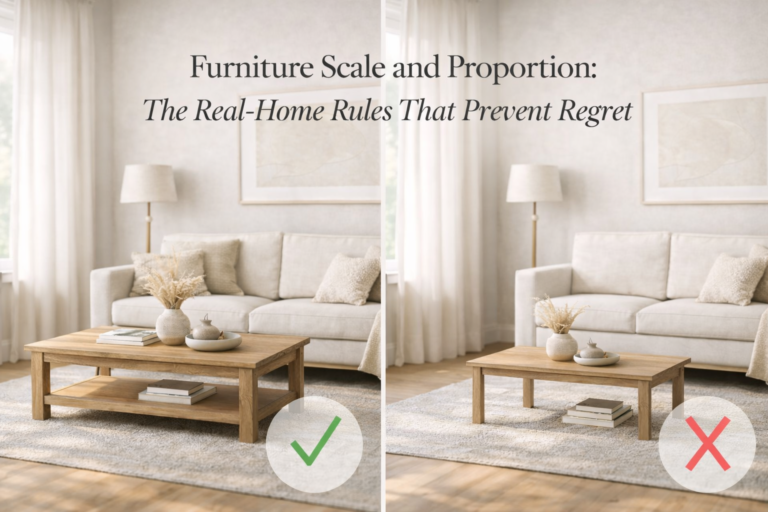
Many furniture regrets have nothing to do with quality. The piece may be beautifully made, structurally solid, and exactly as described, but it still doesn’t feel right once it’s placed in the room. In most cases, the issue isn’t craftsmanship. It’s scale.
Furniture can quickly overwhelm a space when proportions aren’t aligned with the room’s dimensions and everyday circulation. Deep seating in a narrow living room may feel dominant not because the sofa is “too big,” but because it compresses movement and reduces breathing room. Tall cabinets placed under lower ceilings can make a room feel visually heavier. Oversized dining tables in compact spaces often create constant friction, turning daily meals into a space-management exercise rather than a comfortable routine.
This is why furniture choices in real homes need to account for proportion and spatial balance, not just raw measurements on a product page. A few centimeters in depth or height can completely change how a room feels once furniture is surrounded by walls, light, and real movement patterns.
If you want to explore this more deeply, our guides on furniture scale in real homes and furniture proportions in real homes break down the most common scale mistakes and how to avoid them before they become expensive regrets.
Adaptability Is the Most Underrated Furniture Quality
One of the most consistent lessons learned through experience is that adaptable furniture performs best.
Furniture that can be moved easily, repurposed, or reconfigured supports changing needs. Homes evolve families grow, routines shift, spaces change function. Furniture choices in real homes that allow flexibility age far better than rigid, single-purpose pieces.
This is why modular seating, lightweight tables, and neutral designs often outperform trend-driven statement pieces in the long run.
Why People Would Choose Differently the Second Time
Ask people what they would change if they were furnishing the same home again, and patterns emerge.
They would choose:
- Slightly smaller furniture
- More storage-integrated pieces
- Fewer visually dominant items
These insights come directly from living with the consequences of earlier decisions. Furniture choices in real homes become clearer only after experience replaces assumption.
Conclusion
Furniture decisions don’t end at checkout – they continue through daily use.
When furniture choices in real homes are guided by comfort, scale, and adaptability rather than initial appearance, spaces become easier to live in and more satisfying over time.
The most successful furniture choices are rarely the most dramatic. They are the ones that quietly support real life.
Furniture choices in real homes are rarely perfected at the moment of purchase. Most lessons come later after living with the furniture, using it daily, and adapting spaces around it.
This is why many people say they would choose differently if they were furnishing the same home again.
Understanding how furniture choices in real homes actually play out helps avoid common regrets.
Furniture Choices in Real Homes Are Influenced by Routine
Furniture decisions often start with appearance, but daily routines quickly reveal what truly works. In real homes, the most important test isn’t how a piece looks in isolation, it’s how it performs once life happens around it.
A dining table that seemed perfectly sized can start to feel oversized when chairs constantly bump into walkways. A sofa may be comfortable, but if it interrupts natural movement between doors and windows, it becomes a quiet frustration that’s felt every single day. Even storage can become a problem over time when it doesn’t align with habits, when the things you use most have no obvious place, and clutter begins to form in the same predictable spots.
This is why furniture choices in real homes are gradually evaluated less by design and more by usability. The pieces that last are usually the ones that support routine effortlessly, without requiring constant adjustment or compromise.
This is closely tied to flow and spatial interaction, which is why understanding how furniture fits real homes is often the difference between a room that looks good on day one and a room that continues to feel comfortable months later.
Why Simpler Furniture Often Works Better
Furniture with simpler forms, lighter profiles, and flexible placement tends to perform better in real homes.
This is not about minimalism, it’s about adaptability. Because furniture choices in real homes must support change, simplicity often outperforms complexity.
Long-Term Satisfaction Comes From Fit, Not Trends
Trends influence initial choices, but comfort determines long-term satisfaction.
Furniture that supports daily life continues to feel right long after trends fade. This is one of the most important lessons behind furniture choices in real homes.
Conclusion
Good furniture choices are learned through living.
When furniture choices in real homes are guided by realism rather than inspiration alone, spaces become easier to use and more enjoyable over time.
Why do people regret furniture purchases?
Because real use reveals issues that aren’t visible during buying.
Is it normal to change furniture choices over time?
Yes. Homes and routines evolve.
What should guide furniture choices in real homes?
Comfort, scale, and adaptability matter more than trends.
Should furniture choices prioritize looks or function?
In homes, function usually leads to better long-term satisfaction.